
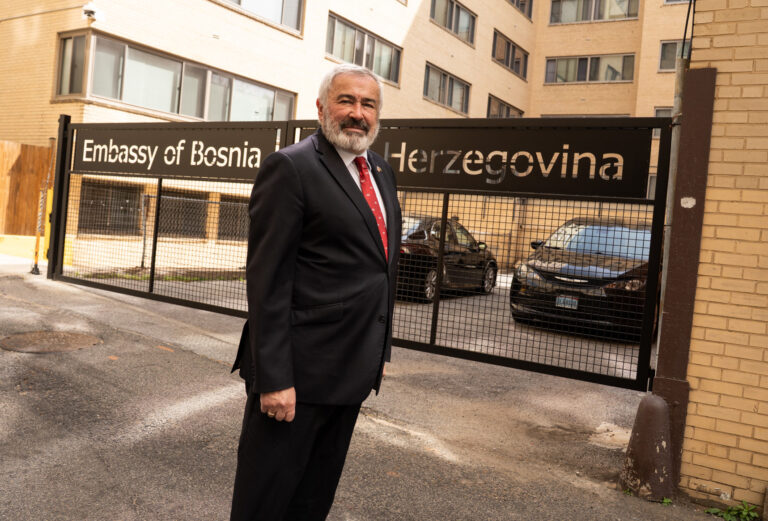
As ambassador of Bosnia & Herzegovina to the United States, Sven Alkalaj represents perhaps the most complicated nation on Earth.
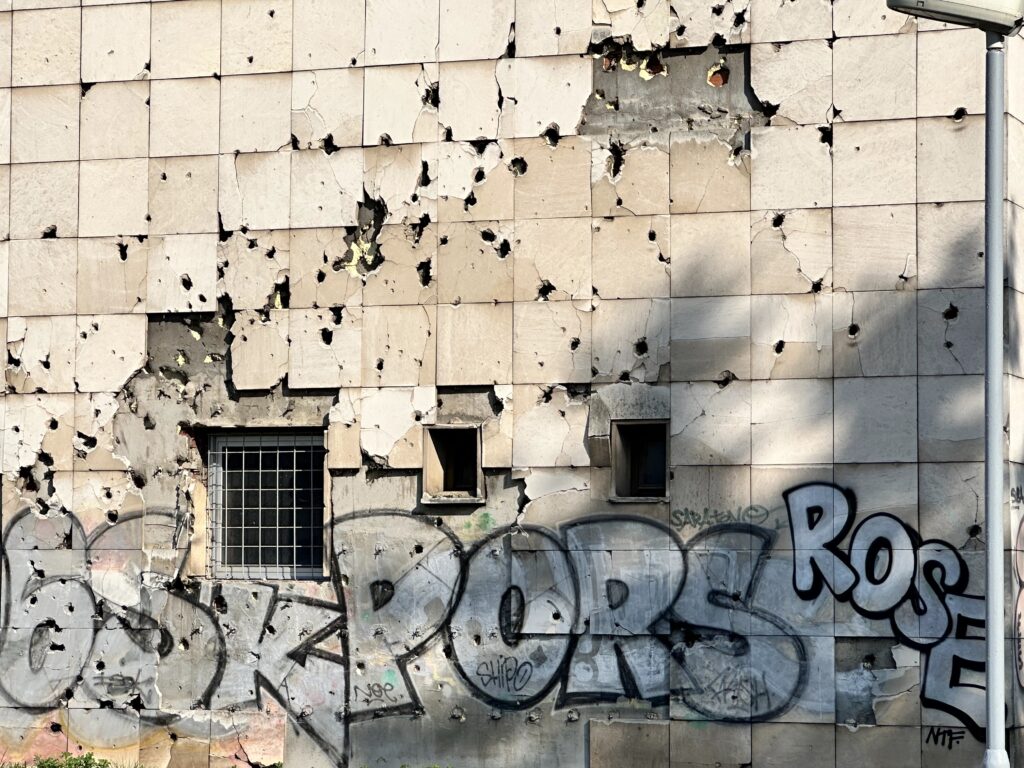
Despite its small size—Bosnia is roughly twice as big as Maryland—this former Yugoslav republic is highly decentralized and fragmented, a consequence of the ethnic wars of the early 1990s that led to 100,000 deaths and the displacement of more than two million people.
The country comprises two main entities—Republika Srpska and the Federation of Bosnia & Herzegovina. That federation, home to mainly Bosniak Muslims and Croats, is divided into 10 cantons as well as local municipality governments. There’s also the self-governing Brčko district in the northeast, which belongs to neither main entity.
Overseeing it all is a three-member rotating presidency (one Bosniak, one Croat and one Serb), as well as a bicameral Parliamentary Assembly and a Council of Ministers. In addition, the federal government has a prime minister and 16 ministers. Under the constitution, it must be composed of eight Bosniaks, five Croats and three Serbs.
“When we started negotiations in Dayton, Ohio, there was a lot of mistrust between these three warring sides,” said Alkalaj, a seasoned diplomat. “So a system was created in which the Serbs got 49% of the territory to create their own entity, Republika Srpska. The Bosniaks and Croats got the remaining 51%.”
Since the war, Bosnia’s population has shrunk dramatically, from 4.5 million in 1992 to around 3.1 million today. Despite its violent past, Bosnia hopes to eventually join the 27-member European Union—which most of its citizens see as the country’s only real path to prosperity.
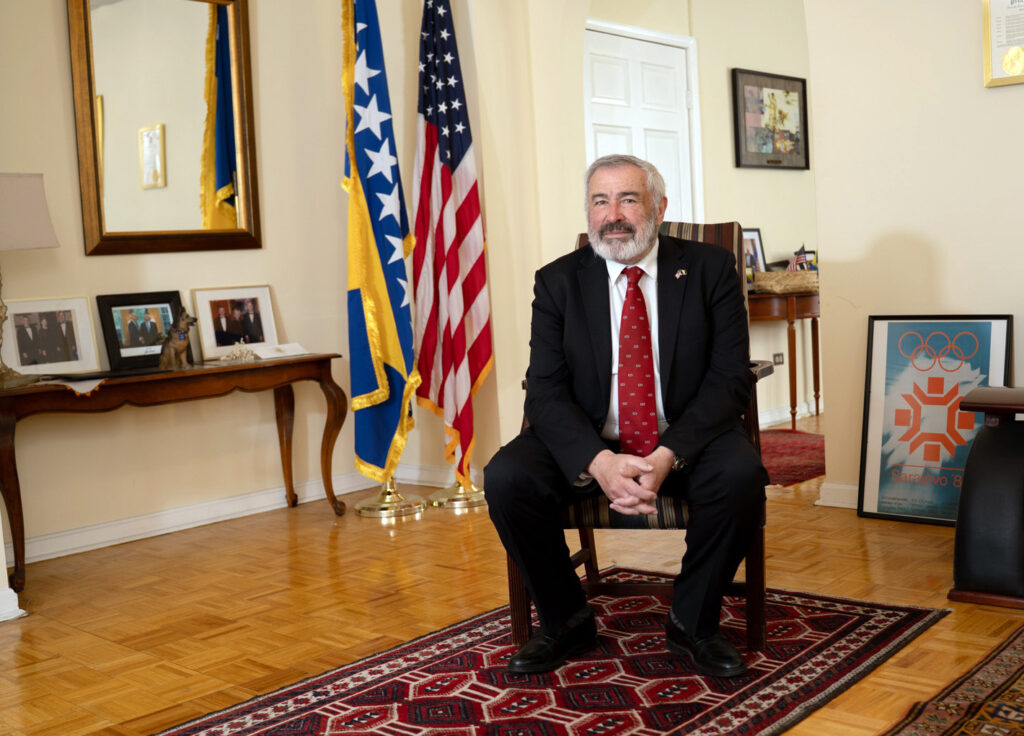
“Two million people were displaced as a result of the war. They went to Germany, Spain and France and the US,” he said, estimating that 350,000 Bosnians immigrated to the United States between 1995 to 2000. The largest Bosnian ethnic communities are found in St. Louis, Missouri, as well as two Florida cities—Jacksonville and Tampa—as well as Atlanta and Hartford.
Alkalaj, 77, was the first ambassador to represent Bosnia in Washington. He arrived in 1993 shortly after the country established its independence, and stayed until 2000.
Born into a prominent Sephardic Jewish family that traces its roots to 15th-century Spain, Alkalaj was raised in Sarajevo, did his basic studies in mechanical engineering at the University of Sarajevo, where he later earned his master’s degree in international relations and economics, with a focus on Latin America.
In 2016, Alkalaj received his PhD in international relations and international law from Bosnia’s University of Travnik; he’s also completed graduate studies at Harvard.
“When the war started, I was representing Energoinvest, Yugoslavia’s biggest exporter, in Bangkok, and the foreign minister at the time, Haris Silajdžić, invited me to join this new government,” he said. “The war was still going on, and his strategy was to rely on the United States to help us fight the aggression coming from Serbia.”
Few people know this, but Alkalaj was not the only candidate being considered for the job; apparently, an ethnic Croat was also in the running.
But then, famed Nazi hunter Simon Wiesenthal intervened, telling the US ambassador in Sarajevo that although he didn’t know Alkalaj personally, “he knew that I belonged to a respected Sephardic family that came to Sarajevo centuries ago, and that a Jew would represent Bosnia better than either a Croat or a Serb.”
Alkalaj would later go on to serve in Brussels as ambassador to Belgium as well as the head of Bosnia’s mission to NATO (2004-07); minister of foreign affairs (2007-12); executive secretary of the UN Economic Commission for Europe in Geneva (2012-14), and finally, Bosnia’s permanent representative to the UN in New York (2019-23), before taking on his current role.
And yet, this same diplomat can never hope to be Bosnia’s president—for the simple reason that the president must legally be an Orthodox Christian Serb, a Catholic Croat, or a Bosniak Muslim.
“If you are not one of these three faiths, then you are not eligible,” Alkala said, noting a 2009 lawsuit brought by his first cousin Jakob Finci, longtime president of Bosnia’s tiny Jewish community. “He won this case, clearly stating that his rights had been violated, but until today it hasn’t been implemented—and it won’t be even for this next election in 2026.”
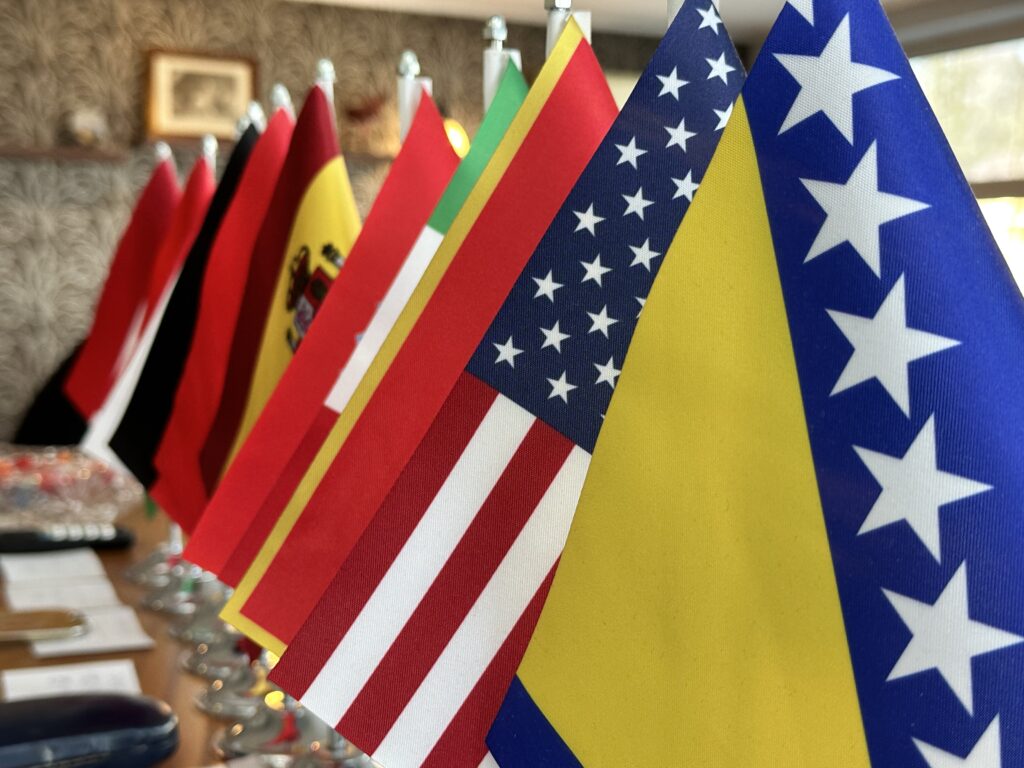
Parliamentary elections are planned for Oct. 4, but the campaign is already in full swing.
In the last such elections, about 78 parties fielded candidates. Serbs and Croats are expected to vote largely on ethnic lines for their two most prominent political parties, Milorad Dodik’s SNSD and Dragan Čović’s HDZ.
Yet SNSD’s opposition is fractured and consumed with infighting; HDZ’s opposition is very weak. In Sarajevo—where a range of Bosniak and multiethnic political parties proliferate—the SDA will continue to claim the authority of being the best protector of Bosniaks, says a former US diplomat with deep knowledge of the region.
“Bosnia is dysfunctional. It is facing the same challenges that have confounded it for at least 20 years, if not in fact since the end of the war,” said the official, who asked not to be identified so that he could speak candidly.
“The US and others had hoped that through common interest and compromise, the Dayton-imposed constitution would be amended over time, allowing for greater national unity,” he said. “Instead, the Office of the High Representative (OHR), with authorities created after Dayton—the vaunted “Bonn Powers”—has intervened repeatedly and seems likely to stay in place.”
More importantly, he said, “the use of Bonn Powers has relieved many—especially Bosniak political leaders—from the responsibility of taking concrete actions and seeking progress in concert with the other constituent peoples, the Croats and Serbs.”
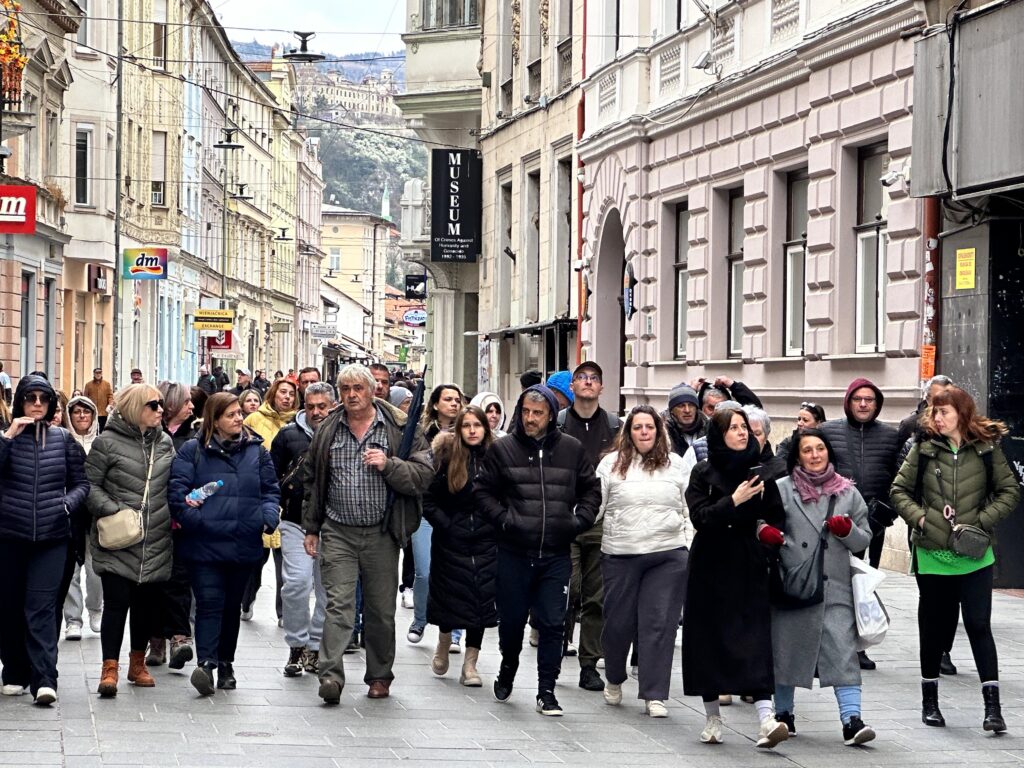
Alkalaj agrees that Bosnia’s convoluted system of consensus governance has often led to paralysis.
“Under our constitution, the presidency is in charge of foreign policy. But there are not many subjects where all three presidents agree,” he explained. “So they usually vote 2-1, and then the third president complains to parliament. It’s very difficult to run foreign policy this way.”
Nevertheless, Alkalaj said he has always let common sense guide his decisions.
“During Russia’s aggression against Ukraine, I was at the UN and we had to decide which side to support,” he said. “I took a decision, based on two members of the presidency, that we would support Ukraine because I didn’t want Bosnia to be on the wrong side of history.”
“All Bosnians, regardless of their ethnicity, look to the United States for support. In that sense, they try to have very good bilateral relations,” he said. “Until six months ago, the leadership of Srpska was under US sanctions. They were not allowed to come to the US, and all trade and investment was suspended because there was so much corruption.”
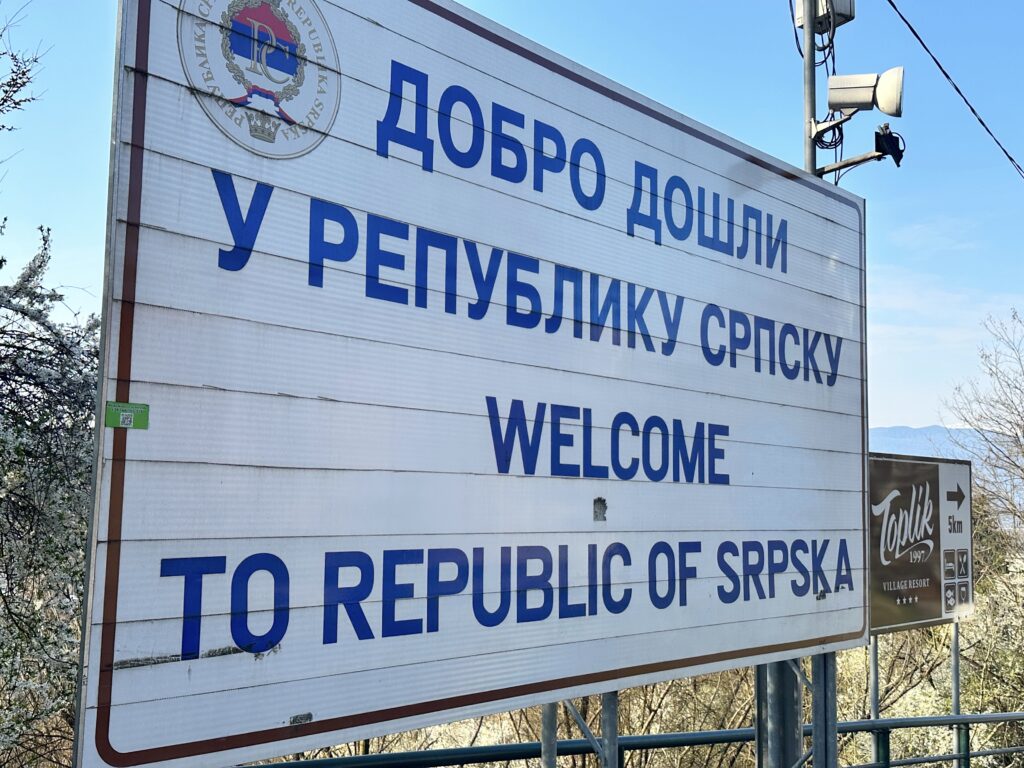
Serb ethnic leader Dodik is now lobbying Washington to support Srpska’s secession from Bosnia and eventually join neighboring Serbia.
“I’m totally against this, and I’m speaking at the State Department, on the Hill and at the White House about it because this because it’ll bring unrest to Bosnia—maybe even a bigger war.”
Also problematic, said the US official, is the “absence of even basic attempts at consensus” among the three-member Bosnian presidency, with one or two of those mem beers making decisions without coordination or guidance from the central government.
“This has led to confused and mixed messages on a range of issues, he said—the latest being Bosnian support for UN Security Council Resolution 2817 condemning Iranian attacks on its neighbors. Serb presidency member Željka Cvijanovic offered it, despite objections from the two other two members.
Such political paralysis makes EU accession extremely unlikely, said the former US official.
“Brussels has been clear that OHR is incompatible with EU membership,” he concluded. “The lack of consensus in decision-making, including on the subject of a possible future in NATO, also means that future membership in the alliance is essentially off the table.”
