
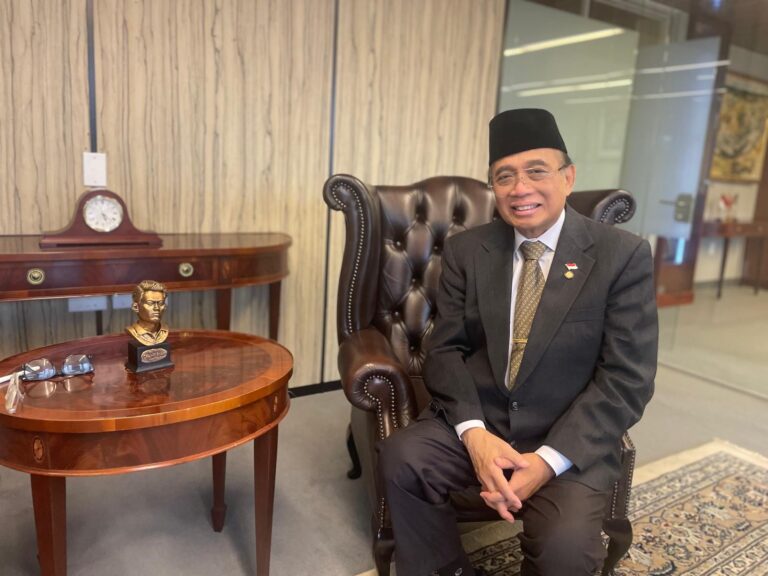
In a week marked by a vice president’s resignation, deepening political rift, record currency plunge and dozens of massive demonstrations in the capital, most diplomats would shy away from the press. But Indonesia’s envoy in Washington was having none of it.
“Political dynamism is common,” Ambassador Indroyono Soesilo told The Washington Diplomat, brushing aside suggestions of chaos. “It happens in many countries.”
Just a day earlier, Nov. 12, Indonesia’s Vice President Gibran Rakabuming Raka, the son of former President Joko Widodo, had submitted his resignation to President Prabowo Subianto, abruptly ending his two-year tenure. Despite public assurances of continued support for Prabowo’s administration from Jokowi, as the former president is known, Gibran’s departure is seen as a sign of a rupture in the alliance between the political forces that form a significant part of the governing coalition.
The turmoil further unsettled investors already concerned about Indonesia’s trajectory. But Indroyono projected confidence in his country’s prospects.
“Our economic fundamental is still okay,” he said, underscoring that American investors poured $3.4 billion into Indonesia’s economy in the first three quarters of 2026, and bought a significant share of the recent bond offering by Danantara, the country’s sovereign wealth fund.
Analysts offer a more complicated picture. Questions about Prabowo’s governance style, his closed inner circle of advisors and populist programs that burden the state budget are increasing perceptions of political risk, said Gregory Poling, senior fellow and director of the Southeast Asia Program at the Center for Strategic and International Studies.
Indonesia’s potential downgrade from emerging market to standalone market by index provider MSCI, the struggling rupiah, cabinet reshuffles and plans to involve Danantara in channeling strategic commodity exports, all raise financial risk perception, Poling told The Washington Diplomat.
“Alarm bells aren’t quite ringing yet, but if foreign investors start to get really spooked, it could be hard to stop a rush for the exits,” he said.
US-Indonesia Comprehensive Strategic Partnership
In 2023, Jokowi and then President Joe Biden elevated bilateral ties to strategic comprehensive partnership, the highest tier of cooperation across diplomatic, economic, security and cultural domains.
“I don’t have to do [it] from scratch,” Indroyono said, highlighting expansions of ties in defense and trade.
However, nearly three decades after the Reformasi movement ended President Soeharto’s 32-year rule, Indonesia stands at a critical juncture. Following a largely successful post-authoritarian transition in 1998, rights groups point out that democratic backsliding has accelerated in the past decade, marked by the co-optation of political rivals and an expanding military role in civilian affairs.
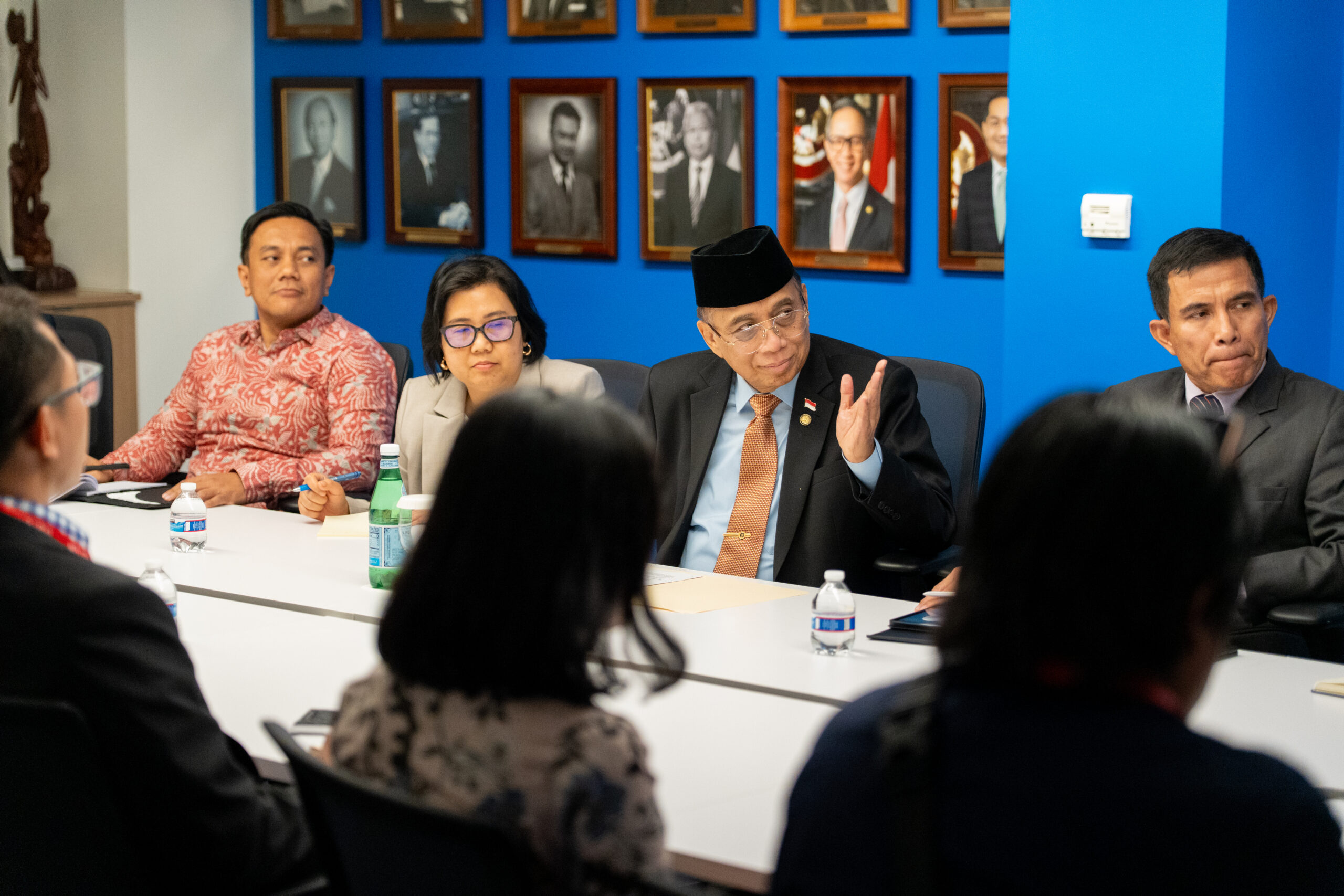
Public anger over the cost of living, corruption allegations and restrictions on civil liberties frequently spilled into street protests during Prabowo’s first two years in office. Now, signs of discontent are emerging among political elites who once formed the bedrock of his governing coalition.
“President Prabowo is now confronted with an internal contradiction in his efforts to consolidate political power, particularly as his popularity has begun to decline,” Dinna Prapto Raharja, founder of the Jakarta-based think tank Synergy Policies, told The Washington Diplomat. “Political parties that once stood firmly behind him are becoming increasingly fluid in their political alignments.”
Meanwhile, rights groups point to growing repression of dissent under Prabowo, whose human rights record has long been scrutinized with allegations tied to his military career under former President Soeharto. Prabowo denies the allegations and has never been prosecuted in court.
Indroyono pushed back against the criticism, pointing to Indonesia’s 2026 presidency of the United Nations Human Rights Council as evidence of the country’s commitment to human rights around the world. He also cited Prabowo’s decision to join the Board of Peace, President Donald Trump’s initiative for Gaza’s reconstruction and postwar governance, underscoring that Jakarta will dispatch peacekeeping forces “once everything is settled.”
Jakarta’s participation in the controversial board has faced domestic and international backlash. Still, it may have bought goodwill from Trump, who recently showered Prabowo with praise as he highlighted the defense agreement signed in April that elevated US – Indonesia military ties.
“He is doing a great job,” Trump said of Prabowo during an Association of Southeast Asian Nations (ASEAN) dinner in Manila last week. “Great leader.”
That public tribute came a year after a hot-mic exchange at the Gaza peace summit in Sharm el-Sheikh, Egypt, where Prabowo appeared to ask Trump to connect him with his son Eric, an executive vice president of the Trump Organization – an interaction that fueled questions about mixing diplomacy with personal business interests.
Indroyono dismissed the leaders’ Sharm el-Sheikh exchange as a “non-issue,” sidestepping questions about leveraging business connections for White House access.
“I’m comfortable with what I’m doing right now,” he said, highlighting preparations to engage with the incoming US Congress and state-level initiatives, including agricultural cooperation with Illinois and semiconductor cooperation with Arizona State University.
Taking troubles in stride
Indonesia’s economy grew 5.47% this quarter, beating market expectations but far below the 8% ambitious target set by Prabowo.
For Indroyono, supporting that goal means pushing for a more favorable US tariff rate. The February trade agreement, which would set a reciprocal maximum rate of 19% on most Indonesian exports with exemptions for 1,819 tariff lines, has yet to take effect amid uncertainty following a US Supreme Court ruling on the president’s authority to impose tariffs.
Washington has since slapped a separate 10% Section 301 tariff on most Indonesian goods, citing failure to effectively ban imports produced with forced labor. The measure is part of the Trump administration’s broader action targeting sixty of the largest US trading partners, which together account for 99.4% of US imports.
Even as he acknowledged that stronger legal protections and bureaucratic reform are needed to attract more investment, Indroyono appeared to take Indonesia’s troubles in stride. While his Washington tenure began in 2025, he is no stranger to diplomacy, having witnessed his late father Soesilo Soedarman present his diplomatic credentials to then-President Ronald Reagan in 1986.
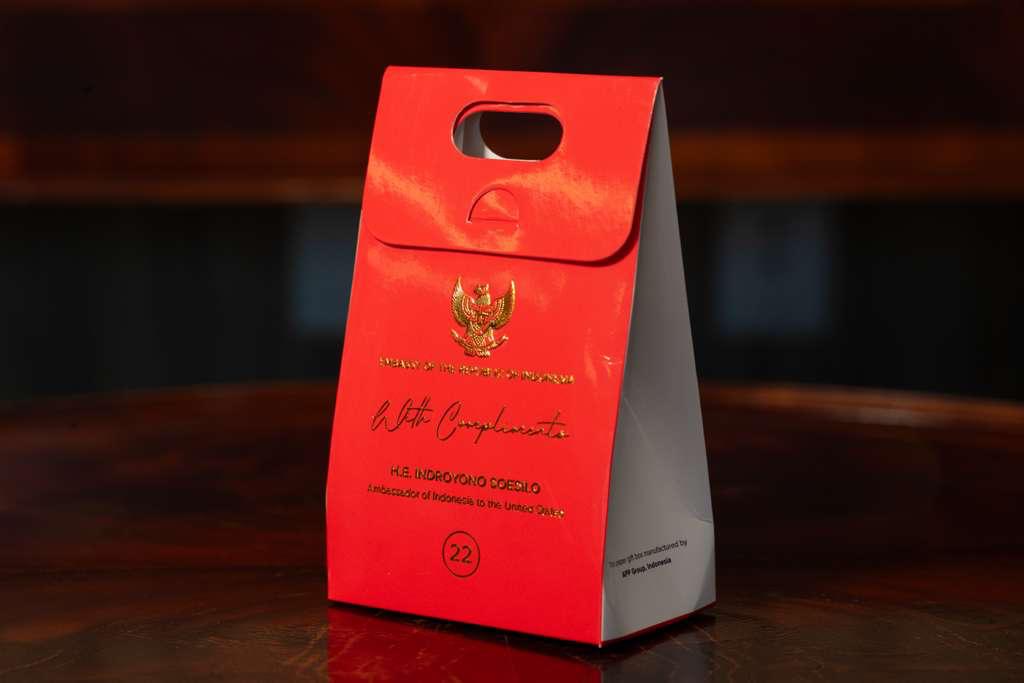
“I am the Indonesian ambassador to the US number 22,” he said, pointing to a row of gift bags of Indonesian coffee emblazoned with the number. “My late father is number 11.”
His eyes lit up as he recounted the Oval Office encounter where Reagan shared his humble beginnings as a radio sports announcer in the 1930s, broadcasting football games of the University of Iowa where Indroyono earned his doctorate in geologic remote sensing in 1987.
The ambassador also has a Master of Science degree in remote sensing for natural resources from the University of Michigan in 1981. He was a Fulbright Distinguished Scholar in 2012, with a research focus on climate change and Indonesia’s marine resources.
“What is my objective? At least I don’t want to be less than what my father has achieved!” he said.
The path he charted is different from that of his father, a career soldier turned politician. As a scientist-technocrat, Indroyono’s government career has spanned technology research and development, marine and fisheries research, social welfare, and maritime affairs, alongside international roles in fisheries and civil aviation.
As with any diplomat, his key mission is to raise his country’s profile: Southeast Asia’s largest economy, the world’s largest archipelago and fourth-most populous country of more than 280 million people. Strategically positioned along vital global shipping routes and immensely rich in natural resources, Indonesia also boasts the world’s largest nickel reserves.
Yet despite the country’s economic heft and geopolitical importance, Jakarta’s global clout is modest.
“I hope that a country as big as Indonesia is not being overlooked by the US,” Indroyono said.
Going forward, he is keen to explore more cooperation in AI, including more investments in data centers despite protests from locals who blame them for water shortages.
“We have 17,500 islands all over Indonesia,” he said. The non-populated islands present, “a lot of opportunity.”
That ambition could face a new regulatory hurdle. Amid heightened scrutiny of U.S. chipmaking giant Nvidia and its embattled CEO Jensen Huang, the Trump administration last week announced tighter export controls on advanced AI chips shipped to five countries, including Indonesia, which Washington considers at higher risk of diversion to China.
A historic renovation
Another major task on Indroyono’s plate: overseeing the massive renovation of Indonesia’s historic chancery at 2020 Massachusetts Avenue NW that began in late 2024. Earlier this year, the embassy moved its operations to Lafayette Centre, at 1120 20th Street NW.
Because the building has heritage protections and requires approvals even for the smallest of changes, the work could take months or years, the ambassador said.
The mansion, listed on the National Register of Historic Places, was commissioned by gold-mining magnate Thomas Walsh and completed around 1903. It is also home to the ghost lore centered around Walsh’s daughter, the Gilded Age socialite Evalyn Walsh McLean.
When asked if he knew what happened to Evalyn’s reported apparitions during the renovations, the ambassador put on his remote sensing scientist hat and turned to technology. Picking up his phone, he showed the app he uses to track unexplainable energy presence around the embassy and his residence.
“Oh, you are there,” he said with an impish grin. “Okay, let’s all live together.”
