
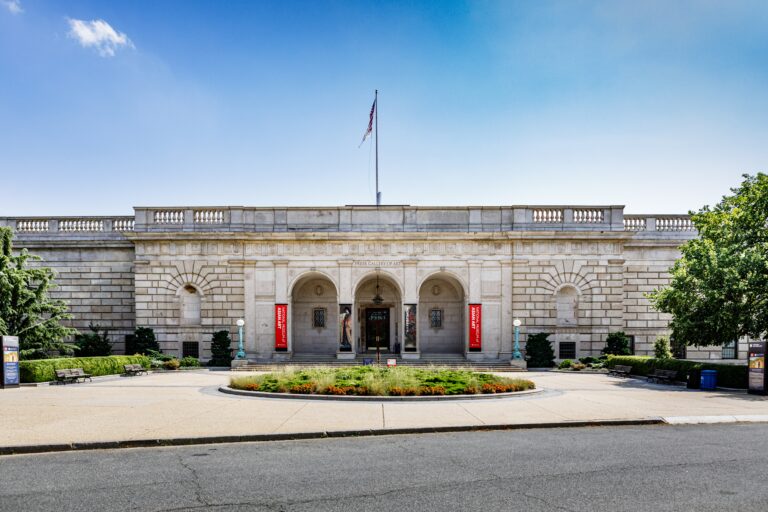
Spectacular inscribed vases, dazzling pen cases, cups teeming with jewels, lavishly decorated basins and fascinating bronze animal sculptures. These are the stars of a special new show at the National Museum of Asian Art.
“From the Louvre: Masterpieces of Islamic Art” demands visitors stop and stare. With just 26 objects on display, the show may sound small, but it packs a major punch. It’s remarkably expansive, featuring pieces from the seventh to 19th centuries made in Islamic regions ranging from modern-day Spain to India. The exhibition takes visitors on a journey through the objects’ histories — as much as is known — from their origins to the Louvre, and now, on loan, to the NMAA.
At the heart of the show is the deceptively simple word: “masterpiece,” co-curator Simon Rettig told The Washington Diplomat.
“We were working on this notion of masterpiece and we decided to go from the Islamic notion of a masterpiece. So in Arabic, the word masterpiece is tuhfa, which means objects of outstanding craftsmanship,” said Rettig, the associate curator for the arts of the Islamic world at the NMAA.
It also conveys the meaning of an exceptional gift — an object so precious, so rare, so outstanding “that you offer it,” he added.
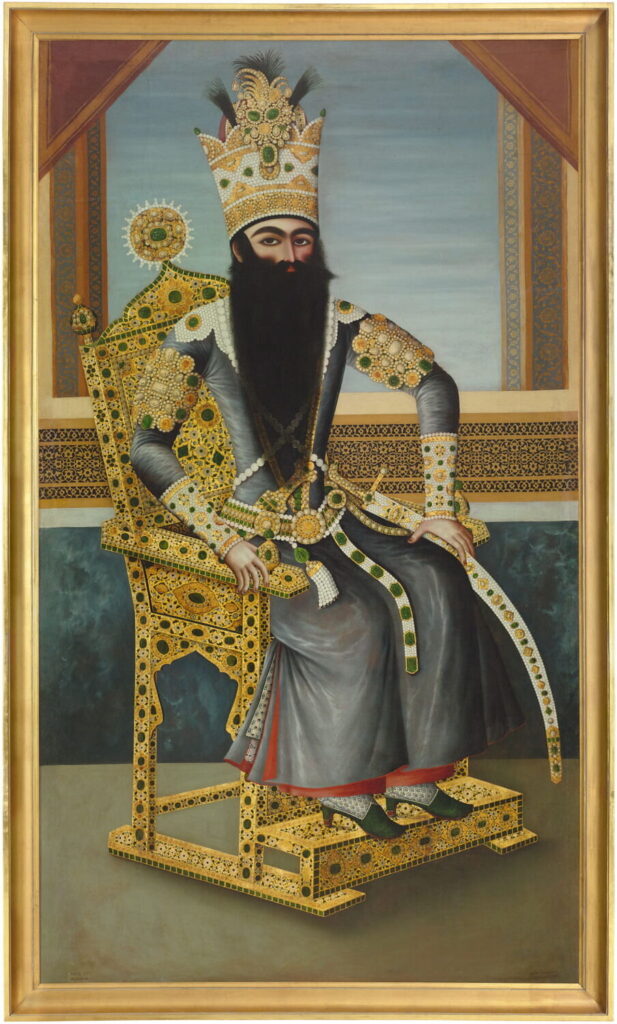
Many of these masterpieces served as diplomatic or political gifts, the exhibition notes, perhaps most memorably in the form of an 18th-century oil painting of the Persian ruler, Fath-Ali Shah Qajar. The exhibition traces the captivating portrait’s diplomatic history as a gift from one emperor to another, Napoleon.
It is pure drama, glitz and grandeur in oil on canvas. Dripping with jewels, the Persian ruler commands your gaze, while a reproduction of Napoleon’s portrait hangs across the hall.
“The guy loved bling,” Rettig said with a laugh, noting that the portrait combines traditional Persian painting with European features.
Let’s backtrack slightly, to the show’s opening piece, a genuine stunner: the brass basin best known as the Baptistery of Saint Louis. It’s an immediate announcement that you are in the presence of a masterpiece, however you conceive the word. Inlaid with silver and gold, the famous basin is impressive in its size and in pristine condition.
“It’s like it was made almost yesterday,” Rettig said.
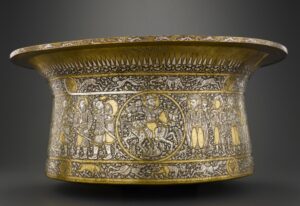
We don’t know exactly where or when it was made, exactly, he added, but likely dates from 14th-century Syria and Egypt. After arriving in France, it transformed into a religious relic with its use for the baptism of King Louis XIII in 1606. The museum traces its constructed history as an emblem of national French identity, alongside the rediscovery of its original Islamic and Eastern Mediterranean identity in the second half of the 20th century.
“It’s fascinating how basically multiple identities come together for an object,” Rettig said.
One visitor was so enthralled that they wondered aloud why the museum didn’t offer stepstools so people could get a better look at the interior of the basin. It’s a fair point. The decorative elements in the interior are stunning, but dense and intricate. Beasts and animals roam along its sides, with epic scenes featuring mounted cavalry, armor and weapons (plus the 19th-century addition of the coats of arms of the House of France with the fleur-de-lis). This masterpiece demands your time, and it’s easily earned.
Several other pieces spark pure joy through the joy. There’s a striking and slightly strange peacock, part of an automaton of molded and engraved brass from Spain dated 962 or 972, and one of the first objects of Islamic art to enter the Louvre in 1793. Then there’s the cast bronze Lion of Monzón, with its wide, gaping mouth that could have been a mechanical device or used as a fountain spout.
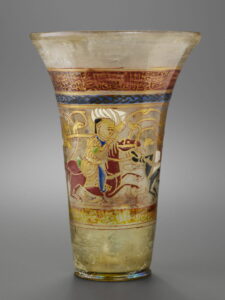
Another animal-themed treasure comes in the form of an exquisite beaker with polo players, made in Syria, probably in Damascus, around 1300-1310. This masterpiece of gilded and enameled glass features vibrant scenes of horses and riders. It entered the Louvre in 1908 after being discovered in 1897 in the altar of the now-destroyed medieval church of Santa Margherita in Orvieto, Italy.
The exhibition came together through a combination of personal connections and good timing — Rettig’s history with the Louvre, the NMAA’s longstanding institutional relationship with the museum and renovations in Paris that allowed the objects to travel abroad.
What interested Rettig and the Louvre was the opportunity to bring these masterpieces to DC and put them “in conversation or in dialogue with our own masterpieces here,” Rettig said.
“It’s a small show in terms of [size], it’s only 26 objects. But oh my god, there is so much to learn about. The history is so rich, so varied,” he said. “This exhibition, it’s a pleasure for the eyes. It’s exciting for the mind. It’s so relevant today. And it’s very glitzy.”
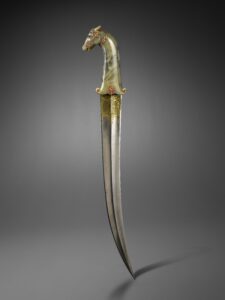
From a magnificent curved dagger with a horse-head hilt to an exquisite engraved jade cup inscribed in Persian, the show deftly reflects on and reconsiders what makes a masterpiece. What a gift for DC.
“From the Louvre: Masterpieces of Islamic Art” runs through Jan. 18, 2027.
Exhibit images provided by Smithsonian National Museum of Asian Art.
