
By: Binalf Andualem Ashenef, Ambassador of Ethiopia to the United States
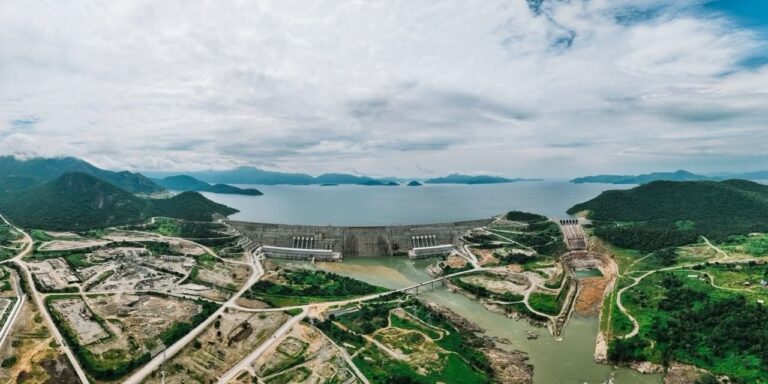
On Sept. 9, Ethiopia will officially inaugurate its Grand Ethiopian Renaissance Dam (GERD). More than just a magnificent feat of engineering. concrete, turbines and flowing water, GERD represents a national ethos, as well as a vision of dignity, self-reliance and equitable utilization of a shared resource.
Constructed entirely through the contributions of Ethiopians—from civil servants and farmers to diaspora communities—GERD stands as a landmark achievement in grassroots financing and public ownership. Ethiopia’s ability to mobilize its own resources in the absence of external support is not merely an infrastructure milestone, but a political and moral declaration: Ethiopians are determined to lift their nation out of energy poverty with their own hands.
The Abbay River, known to the rest of the world as the Blue Nile, is Ethiopia’s most abundant and strategic water resource. Accounting for over 70% of its surface water and coursing through two-thirds of its landmass, the river is Ethiopia’s lifeline. Although the Abbay River contributes 86% of the Nile’s water, Ethiopia has been unable to harness this asset to address its own needs—until now.
Ethiopia’s population is projected to surpass 230 million by 2050, making energy access a matter of urgency rather than choice. Today, nearly 60 million Ethiopians lack access to electricity, a stark reality that undermines not only livelihoods but also the ability to industrialize and achieve climate and development goals. The implications are especially critical for Ethiopia’s youth. More than 70% of all Ethiopians are under the age of 27, and over 32 million are enrolled in school. Meeting their future aspirations—employment to innovation—requires reliable, renewable energy. GERD is a decisive step in that direction.
With a capacity of 5.15 gigawatts and annual production potential of nearly 15,760 gigawatt-hours, GERD will more than double Ethiopia’s energy output. This is essential for industrial growth, job creation, and the gradual phasing out of unsustainable biomass energy consumption, which has led to severe deforestation and indoor pollution.
Beyond its domestic relevance, GERD could make Ethiopia a regional energy hub. It already supplies electricity to neighboring Sudan, Kenya and Djibouti, making GERD a powerful catalyst for regional economic integration. Cross-border energy trade will not only generate revenue but also promote economic interdependence—an antidote to mistrust and isolation in the Horn of Africa.
Sudan and Egypt also stand to benefit in tangible ways. GERD helps regulate seasonal floods, reduces sedimentation in downstream reservoirs, and minimizes water loss through evaporation. In practical terms, these things are already happening, before the dam’s full commissioning.
Some critics wrongly portray the dam’s effect on Egypt, but that perception is not rooted in technical reality. Hydroelectric dams do not consume water; they pass it downstream after generation. GERD operates under the same principle, so claims of water “loss” or obstruction fundamentally misrepresent how a dam works.
Despite these merits, GERD has been the subject of diplomatic contention, especially with Egypt. Cairo’s objections to the project arise not from the dam’s design or operation, but from a longstanding water allocation paradigm rooted in colonial-era treaties.
A 1929 agreement between Britain and Egypt, followed by a 1959 bilateral arrangement between Egypt and Sudan, effectively allowed Egypt and Sudan to monopolize the Nile’s waters. Under these accords, Egypt claims 55.5 billion cubic meters annually, while Sudan receives 18.5 billion. Other nations including Ethiopia were not party to these agreements and got nothing.
Such an arrangement, devised under imperial logic to serve colonial interests, lacks both legal standing and moral legitimacy in international law. Ethiopia, which contributes over 86% of the Nile’s waters, cannot accept a framework that denies it any formal share.

The Nile River Basin is undergoing a transformation. In 2010, most of the Nile Basin countries adopted a Cooperative Framework Agreement to replace outdated treaties with a fair, inclusive, and basin-wide legal framework. This agreement, which took effect in October 2024, emphasizes equitable and reasonable use of the Nile, sustainable development, and mutual respect.
Ethiopia encourages Egypt to join this multilateral process. Sustainable water governance in the 21st century demands cooperation—not confrontation—and forward-looking solutions, not backward-looking claims. GERD is not a zero-sum project, but a project for shared prosperity, built with the intention of uplifting not just Ethiopia but the broader region.
The dam’s very name, Renaissance, is a call to rise together. And it’s in this spirit that Ethiopia invites its neighbors to turn the page on discord and write a new chapter of cooperation, dignity and development.
—
Although the author is Ethiopia’s ambassador to the United States, this piece reflects his personal views and not the official position of the embassy or the Ethiopian government.
