
Two former Soviet republics that have been sworn enemies ever since the breakup of the USSR are suddenly on the verge of making peace.
Since their independence in 1991, predominantly Christian, landlocked Armenia and mostly Muslim, oil-rich Azerbaijan have fought numerous wars and accused each other of human rights abuses, ethnic cleansing—even genocide.
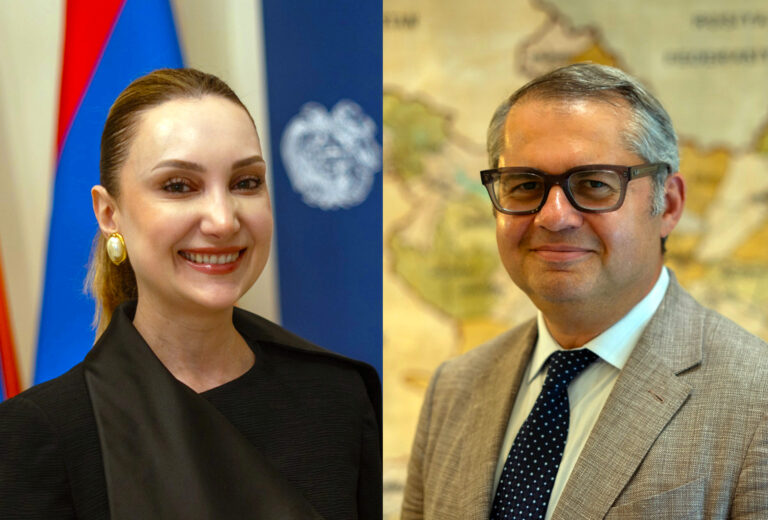
But now, the DC-based ambassadors of both countries say it’s time to end the bitterness and bloodshed once and for all.
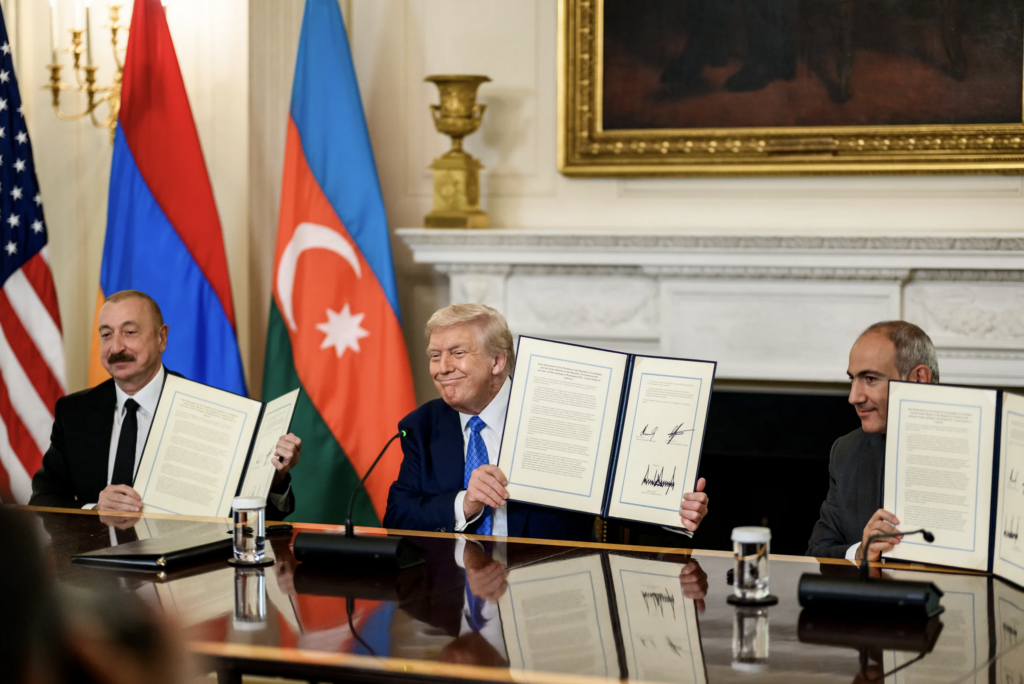
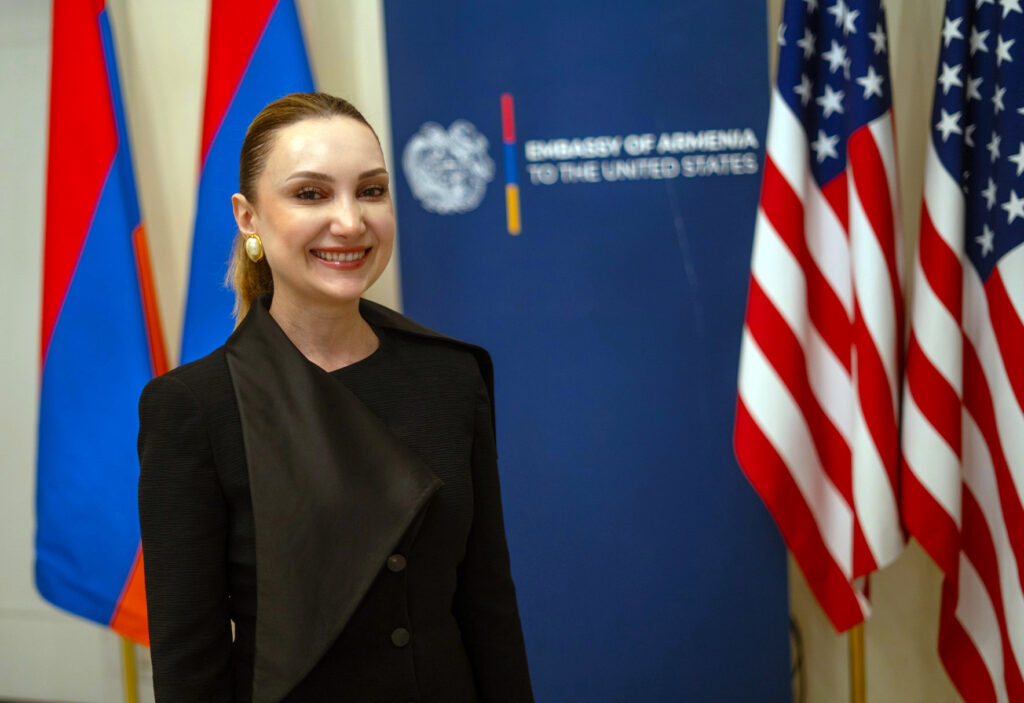
Armenia’s Lilit Makunts and Azerbaijan’s Khazar Ibrahim—both of whom presented their credentials to President Joe Biden on Sept. 15, 2021—spoke separately with The Washington Diplomat. The interviews followed an Aug. 8 White House ceremony featuring President Donald Trump, Azerbaijani President Ilham Aliyev and Armenian Prime Minister Nikol Pashinyan.
“Now they’re friends, and they’re going to be friends for a long time,” said Trump, seated between his guests as all three men displayed documents. “You two are going to have a great relationship. If you don’t, call me and I’ll straighten it out.”
The Aliyev-Pashinyan summit got quickly overshadowed by Trump’s Aug. 15 meeting in Alaska with Russian President Vladimir Putin to end the Kremlin’s war with Ukraine, not to mention the administration’s persistent, yet unsuccessful, efforts to broker a permanent ceasefire in Gaza between Israel and Hamas.
On the other hand, Trump—who’s made no secret of his desire for a Nobel Peace Prize—did manage to resolve recent conflicts between the Democratic Republic of Congo and Rwanda, between India and Pakistan, and between Thailand and Cambodia.
“We can see that Trump was influential in a very short time to bring peace to different corners of the world,” said Azerbaijan’s Ibrahim. But when asked if the Pashinyan-Aliyev summit could have taken place without Trump’s intervention, Ibrahim reminded us that he’s a career diplomat.
“Probably we would have had it,” he said cautiously, “but not that fast, and not that deep.”
This is one reason, Ibrahim said, he was “absolutely not” surprised by his country’s rapprochement with Armenia after so many years of hostility.
“My president has always been about peace and prosperity. He proved it in the last decade by championing most of the developments in the region. Our relationship with Armenia is next in line,” he said. “Secondly, we have worked really hard—not only Azerbaijan but also Armenia—on direct negotiations for quite a long time. So that, of course, makes me less surprised.”
Makunts heaped similar praise upon all three leaders, noting that “Armenia and Azerbaijan were negotiating for a number of years, and this past March our government announced that peace talks had been completed, and that both sides had agreed on 17 provisions.”

She added that “this breakthrough would simply not have been possible without President Trump’s engagement and commitment to peace in our region. We will forever be grateful to him for bringing both sides together.”
A political appointee, Makunts, 42, became Armenia’s first female ambassador to the United States in 2021. Before that, she was majority leader in Armenia’s parliament representing the My Step coalition (2019-21) and was also minister of culture in Pashinyan’s first cabinet (2018-19).
“Despite the grievances of the past, which are undeniable, we need to move forward,” she said. “Armenia will benefit economically from the unblocking of transport routes, and our prime minister has outlined Armenia’s desire to become a hub for commerce—from the Caspian to the Mediterranean, from the Persian Gulf to the Black Sea. This brings us one step closer to that reality.”
From bitterness to friendship: A long road ahead
Slightly bigger than Maryland, Armenia is home to just under 3 million people. In the year 301 AD, it became the world’s first country to adopt Christianity, and its unique 39-letter alphabet dates to the year 405 AD. About 97% of Armenia’s inhabitants follow the Armenian Apostolic Church, with Catholics, Jehovah’s Witnesses, Jews and others making up the remaining 3%.
Yet far more Armenians live outside the country than in it, with large and influential diaspora communities in the United States, Russia, Georgia, Ukraine, France, Canada, Lebanon, Turkey and throughout Eastern Europe and the former Soviet Union. This is because of the genocide that took place between 1915 and 1923, when the Ottoman Turks slaughtered roughly 1.5 million Armenians in a murderous wave of ethnic cleansing. Another eight million were forced to flee.
Eric Hacopian is an Armenian-American consultant who for 35 years advised Democratic politicians in California, home to the world’s largest Armenian diaspora community. Speaking from Yerevan, he said that Azerbaijan’s Aliyev never agreed to sign a peace treaty—nor does Hacopian expect one to be signed.
“What’s important here is the US role in preventing future Azeri aggression at a time when Armenia is working on its deterrence capabilities,” said Hacopian, who also hosts a weekly political show on CivilNet TV. “This agreement buys us three to four years. You’d have to be a fool to believe that peace is possible with a regime like the one running Azerbaijan, whose existence is justified only by having an Armenian enemy.”
The bitter ethnic conflict over the disputed Nagorno-Karabakh region began in 1988, when both countries were Soviet republics. It erupted into a full-scale war that continued until a 1994 ceasefire, yet tensions continued for years as the region fell under the control of the Armenian-speaking, self-proclaimed Republic of Artsakh. In 2020, another war broke out, and Azerbaijan regained control of all the occupied territories it had previously lost.
Three years later, in September 2023, Azerbaijan launched a fresh military offensive which led the exodus of 120,000 people—nearly the entire Armenian population—and Artsakh’s official dissolution on Jan. 1, 2024.
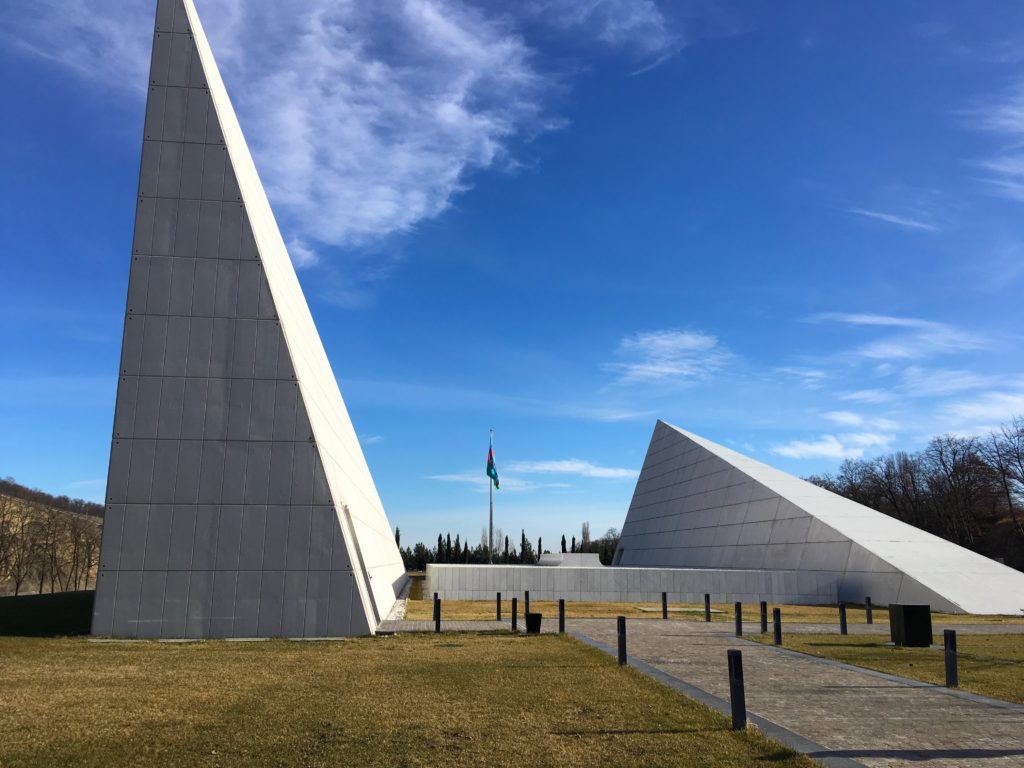
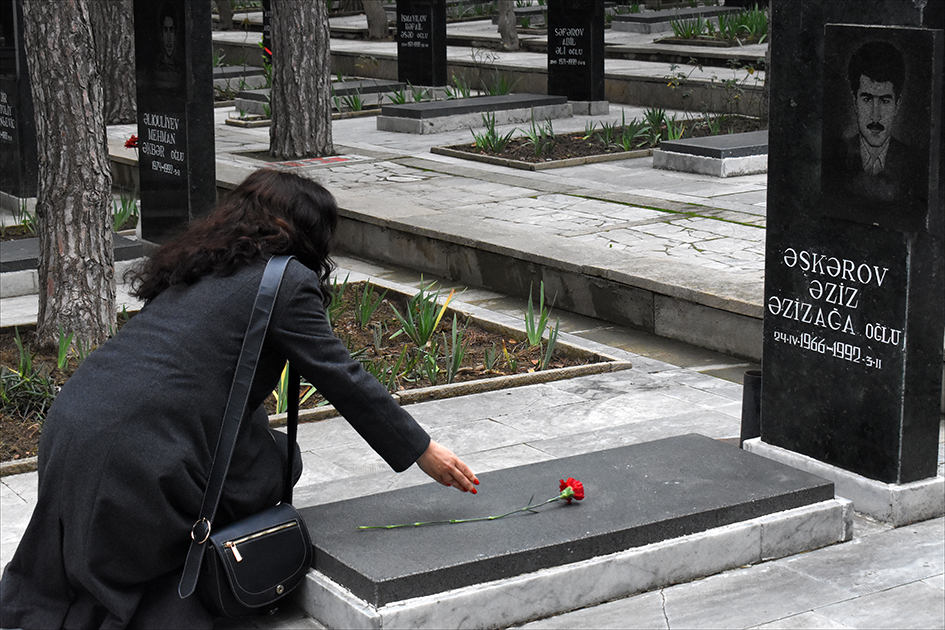
Armenia subsequently accused Azerbaijan of ethnic cleansing, though the Azerbaijanis point to the earlier Khojaly massacre of Feb. 26, 1992, in which Armenian forces were said to have killed at least 200 Azerbaijani civilians—and possibly as many as 1,000—depending on the source. Genocide museums in both Yerevan and the Azerbaijani city of Quba attest to the horrific crimes attributed to each countries’ respective enemies.
Yet both Armenia and Azerbaijan appear to be willing to overlook their past tragedies in the name of a brighter future.
“We have solved the Karabakh issue in every aspect,” Ibrahim said. “The documents that were signed in Washington clearly state that we both recognize each other’s territorial integrity, and that Armenia recognizes Karabakh as part of Azerbaijan, which is really good news. This is how neighbors should behave.”
Ibrahim, 47, took over the DC ambassador job in 2021 from Elin Suleymanov, who held the position for 10 years before being reassigned to London in early 2020.
Born and raised in Lankaran, a town of about 90,000 just south of Baku, Ibrahim has a master’s degree in international relations from Baku State University, and another master’s in security studies from Washington’s Georgetown University. He previously served at the Azerbaijani Embassy here from 2002 to 2005—where his portfolio included political, military and public diplomacy issues—then came back here from 2009 to 2011 as deputy chief of mission.
He was also a spokesman for Azerbaijan’s Foreign Ministry as well as ambassador to NATO until 2017, then envoy to Turkey for the four years preceding his current stint in DC.
“Among our people, there was and there still is some bitterness. But at the same time, you can see we are not that different. For centuries, we lived side by side in a very friendly environment,” he said. “Both Azerbaijan and Armenia are destined to prosper when we trade with each other. This is a golden opportunity for all three countries of the South Caucasus—Georgia included.”
Azerbaijan occupies an important place in history as the site of the world’s first oil well, drilled in 1846. By the 1920s, Azerbaijan was producing more than half the planet’s petroleum. Today, this Maine-sized republic bordering the Caspian Sea still relies on energy exports for most of its revenues—helping to turn its capital city, Baku, into a mini-Dubai. About 97% of its 10.3 million inhabitants are Muslims, with no restrictions placed on the practice of other faiths.
“This is a watershed moment, not just for Armenia and Azerbaijan, but also for the broader South Caucasus. After decades of conflict, we’re turning the page on historical grievances and charting a course defined by shared peace and prosperity,” said Makunts, adding that leaders of the US House and Senate—along with more than 100 members of the Congressional Armenian Caucus—are on board with the deal.
Makunts also insisted that “Armenia is not giving up anything,” and that “all the arrangements on transport and communications are going to be launched in line with our territorial integrity, sovereignty and jurisdiction.”
TRIPP: A gain for the United States, losses for Russia, Iran
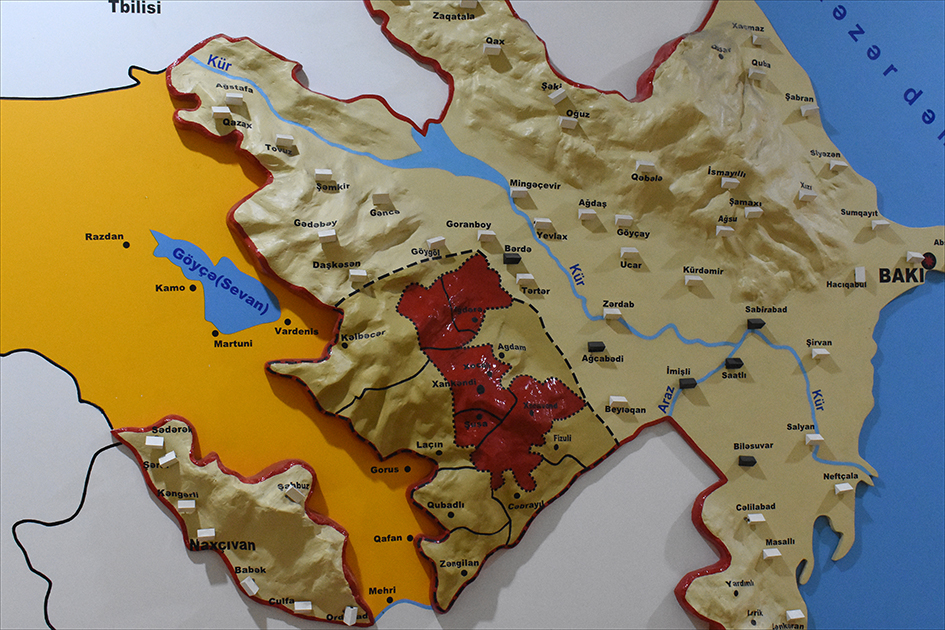
Central to the deal is the Trump Route for International Peace and Prosperity (TRIPP), formerly known as the Zangezur Corridor. This trade corridor aims to connect Azerbaijan with its exclave, Nackchivan—separated by a swath of Armenian territory—and is to be developed by US companies to include rail and communication lines as well as oil and gas pipelines.
“This TRIPP Corridor will not only link Azerbaijan to its exclave, but all of Asia to Europe,” Ibrahim predicted. “And Armenia will be an even bigger beneficiary than Azerbaijan because this will give it a link to Europe and Asia. All these corridors will bring prosperity and trade.”
According to Forbes magazine, TRIPP “would forge a pathway from the Stans in Central Asia down through the Caucasus to Turkey and beyond to the world, effectively revitalizing the old Silk Road, which means it would bypass both Russia and Iran.”
Russia is the big loser here, it said, having dominated the terrain for over 200 years, “imposing a chokehold and Moscow-centric dependency on its backyard from Turkmenistan to Kyrgyzstan. Those economies now stand to be liberated geopolitically from effective control by Russia.”
Tehran isn’t too happy about TRIPP either, warning Aug. 9 that “this corridor will not become a passage owned by Trump, but rather a graveyard for Trump’s mercenaries.”
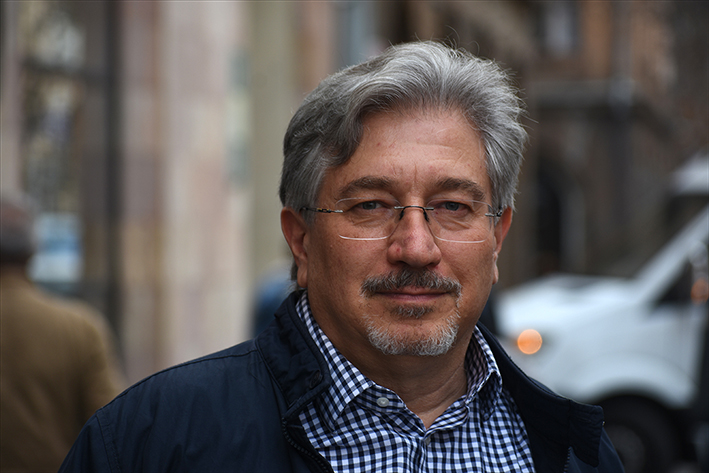
Sergey Minasyan, who was Armenia’s ambassador to Romania from 2017 to 2023, is deputy director of the Yerevan-based Caucasus Institute. He’s also an expert on conflict resolution.
“Both sides are trying to exploit the eagerness of the Trump administration to be involved in the peace process,” he told The Diplomat. “For Armenia, especially at this moment, it was important because the initiative announced in Washington creates additional security guarantees for us.”
Yet the wild card remains Armenia’s 2026 parliamentary elections, in which Pashinyan’s position is “quite fragile,” Minasyan suggested.
“Armenian society is very divided after the results of the 2020 war, and the 2023 deportation of Armenians from Nagorno-Karabakh,” he said. “Nobody’s actually happy with these concessions, but we should also understand that they made a very pragmatic decision that was actually a clear reflection of a new security situation in the region.”
Asked about a potential opening of embassies in each other’s capitals, he said “this could be possible only after the signing of a peace agreement, and I don’t think that’s realistic before next year’s parliamentary elections in Armenia.”
At this stage, it’s just a political declaration, he said—nothing more.
For the moment, he said, Russia appears to be losing ground in Armenia and the South Caucasus as a whole. But it’s possible, he added, that “after a ceasefire in Ukraine, Russia will probably try to come back to the Caucasus when it has more resources and time to pay attention.”
Potential economic benefits for the South Caucasus
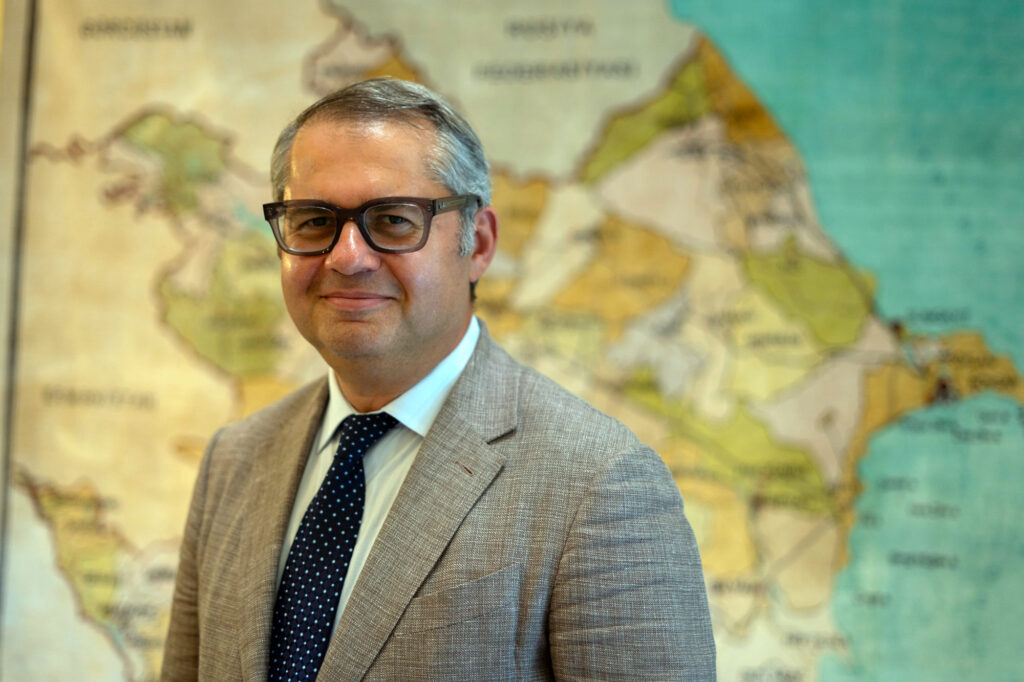
Alex Raufoglu is a Baku-born journalist who now freelances from Washington. Asked what the summit means to him as an Azerbaijani, he replied: “Nothing at this point, to be honest, given that we’ve yet to see a real peace agreement. I’ll only believe it when I see it.”
If, however, it comes to fruition, he said, there’s no doubt it would be a diplomatic win for Azerbaijan, “solidifying territorial gains and outlining a US-backed ‘Trump Route’ through Armenia for economic and strategic ties, bypassing both Russia and Iran.”
Yet Raufoglu remains deeply skeptical, given the region’s bitter history.
“While leaders sounded committed, lasting peace is complex. It requires societal involvement and overcoming hurdles like potential constitutional changes and the need for broad public support,” he said. “Without a genuine shift in societal attitudes, the agreement’s foundation could remain fragile.
At any rate, the cancellation of Armenia’s claims against the Azerbaijani government “is the most unacceptable part of this so-called peace agreement,” Hacopian said.
“Removing the chance to continue with the lawsuits codifies the second Armenian genocide into law, since ethnic cleansing—under international law—is genocide. It is a moral, political abomination,” he said, noting that there cannot be any debate on whether the Armenian genocide took place.
On the question of recognizing the 1915 genocide, Hacopian argues simply that it happened.
“Outside of the Turkish and Azeri state sectors, no one questions that fact,” he said when asked why only 34 countries—beginning with Uruguay in 1965, and most recently the United States in 2021, during the Biden administration—have officially recognized the genocide. “I couldn’t care less who recognizes it or who doesn’t, since anyone who does not is simply embarrassing themselves by not having any moral compass.”
Not surprisingly, Makunts took a far more diplomatic approach to what’s clearly a sensitive and emotional issue for millions of Armenians around the world.

“We are grateful to all the countries that have recognized the Armenian genocide, including the US,” she said. “That chapter of history is tragic, and it’s not possible to erase history—but we need to move forward. Armenia and Turkey are trying to normalize relations and have open borders. We hope the recent initialing of the peace agreement will serve as an impetus.”
Makunts, who’s returning to Yerevan at the end of this month, added that “it’s been an honor of my lifetime to serve my people in this capital.”
Ibrahim praised his counterpart warmly, telling the Diplomat: “I know Lilit from the very first day I came here. We were always friendly and very honest with each other. I think she’s done a very good job.”
He added: “There is huge support for this agreement in both countries. Our embassy is receiving a lot of letters from Armenians thanking us. We’ve never had this before. We really hope this will mark a new page in Azerbaijan-Armenian relations.”
And what about nonstop Yerevan-Baku flights—a straight-line distance of only 284 miles?
“Never say never,” Ibrahim suggested. “I’m pretty confident it will happen one day.”
