
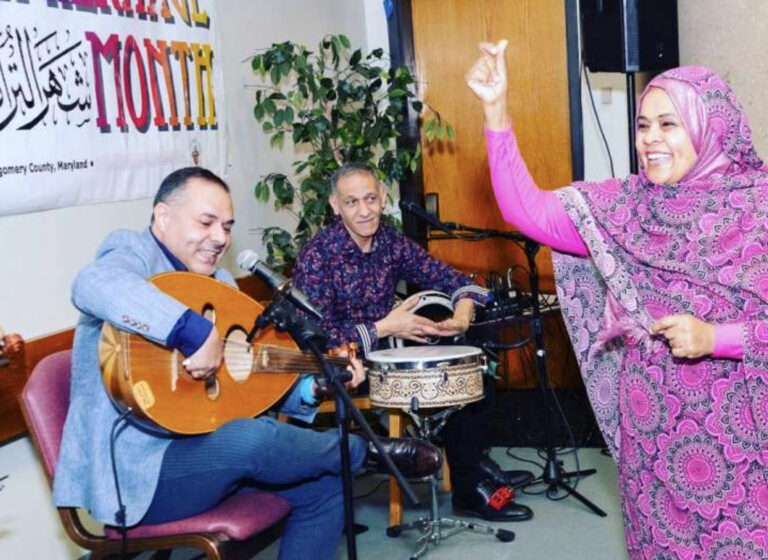
Born in Syria and raised in Saudi Arabia, local musician Muath Edriss takes his oud seriously.
Edriss, 52, is a singer, composer and performer. His professional career, in fact his whole life, revolves around the oud—an ancient instrument beloved throughout the Middle East.
First appearing in medieval Persia in the 7th century, the pear-shaped oud is considered the parent of the European lute.
“All other instruments, like the sitar, came from the oud,” Edriss said in a recent interview. “When you play an oud, you hold it very close to your heart. It also translates your feelings. If you give the same score to three musicians, all three will play the notes differently. And the way you move your finger on the oud is different from one player to the next.”
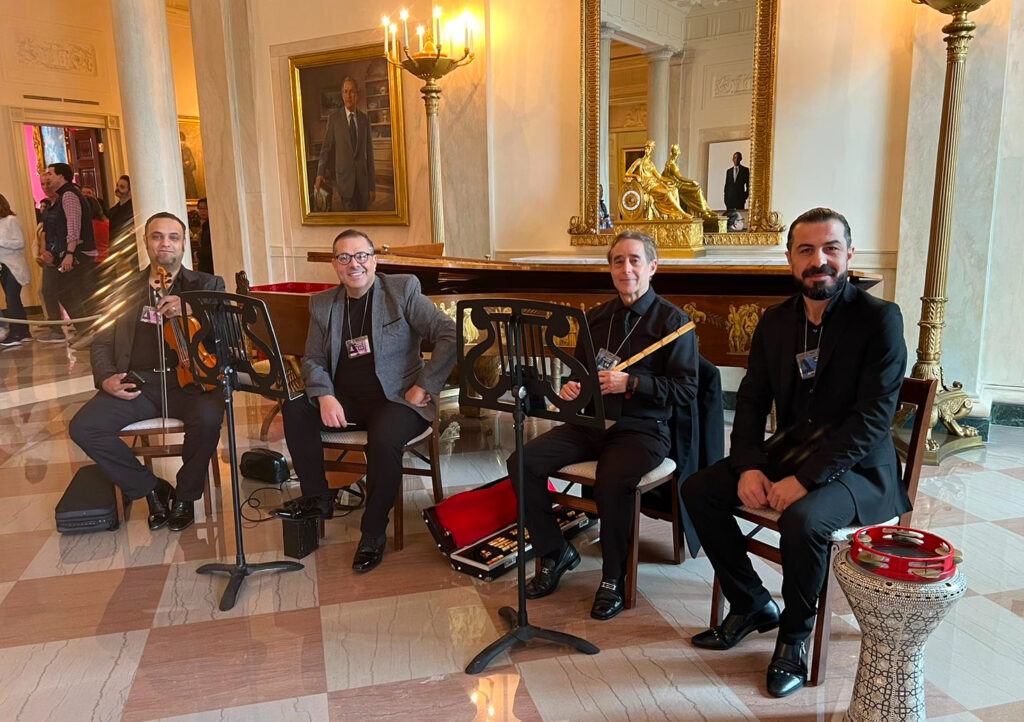
Edriss’s claim to fame: he’s the first and only Arab ever to perform inside the White House, singing in Arabic.
“I did this in 2023 for Arab Heritage Month. It was open to visitors,” he said. “I also performed at Blair House last year with the State Department, which has invited me many times.”
In fact, Edriss has 62 songs of his own. All of them can be found on his YouTube channel, which has nearly 50,000 followers.
“I always say, fame has nothing to do with a musician’s skills. It all depends on how you promote yourself, and what connections you have,” he told us. “I picked the oud because I needed an instrument to help me sing. It’s not easy to sing while playing violin. And like any professional, I stay with one instrument.”
Originally from Syria’s Mediterranean port of Latakia, Edriss left with his family for Saudi Arabia in 1982. He ended up spending more than 30 years in that country, where among other things he worked as a producer for Saudi TV and the MBC network. Edriss also has two sisters in Saudi Arabia, as well as 12 Saudi nieces and nephews.
“I started singing when I was a kid. Of course, I was touched by my father’s beautiful voice. He was a gourmet when it came to music,” he said. “My sister also has an angelic voice. But playing oud? That was out of jealousy because my older brother Firas played oud, and the whole family was crazy about him. So in 1998, I bought my own oud and taught myself how to play it.”
Named as a Best Voice winner in 2001, Edriss recalled that his career was launched after a singing competition in Lebanon.
“Rotana Music Group approached me and wanted to make an album, but I paid for the album and they did the distribution,” he said, referencing the Riyadh-based Saudi record label, which is the largest in the Arab world. “From then, I became a professional musician. In college, I studied law but switched to fine arts because I didn’t want to be a lawyer. I wanted to be a musician.”
Following his heart—and going against the wishes of his family—Edriss enrolled in the Arabic Music Institute in Damascus, graduating from there in 2006.
Edriss relocated to the US in 2013 and made a name for himself as “DJ Muath.” In 2018, the Washington Post named him “one of Adams Morgan’s brightest new additions, spinning dabke, rai, chobi and other Middle Eastern dance music” at The Green Zone.
These days, Edriss says he doesn’t play at restaurants or pubs—only fine classic venues. Among other things, he’s performed at numerous diplomatic events as well as private gigs including a Jewish engagement party for a friend, where he sang the folk song “Tumbalalaika” in Yiddish.
Edriss has also the US national anthem, “Star-Spangled Banner,” into Arabic, an endeavor that took him three months.
Among other things, he’s the official ambassador of the Arab America Foundation, a DC-based nonprofit that connects Americans of Arab origin. This past April, he was invited by Rep. Rashida Tlaib of Michigan to perform under the Capitol Rotunda. And he’s also a visiting lecturer in music at Indiana University in Bloomington, as well as a member of the Syrian Syndicate of Artists and the American Federation of Musicians.
As if that’s not enough, Edriss directs the musical show for the four Arab countries that participate in the annual Winternational festival: Iraq, Syria, Qatar and Yemen.
Warren David is co-founder of the Arab America Foundation. A third-generation Arab-American of Syrian and Lebanese heritage, he first met Edress about 10 years ago when the musician was performing at a dinner for Arab engineers.
“We were leaving the event and I told my wife, ‘this guy has potential,’” David recalled. “I went back and introduced myself. It’s amazing how he went from being a diamond in the rough to such a seasoned musician, composer and vocalist.”
David said he’s “very proud” of Edriss for several reasons, but mostly for being so personable likeable—and for accomplishing so much in such a short time since his arrival in this country.
“For Arab-American Heritage Month in 2023, he and a group of other musicians performed in the White House, right in front of the Obama portrait,” David said. “To my knowledge, he’s the first Arab-American to perform Arabic music in the White House—and maybe the last. We certainly hope for better days ahead.”
Added Edriss: “When we leave this earth, nothing remains except our legacy. I’m trying to leave my impact on the world.”
