
Peter Mandelson, Britain’s outspoken ambassador to the United States, was fired on Sept. 11—after barely half a year on the job—following the discovery of emails that revealed the extent of his personal ties with disgraced financier and convicted sex offender Jeffrey Epstein.
The New York Times reported that Mandelson’s dismissal “cast a shadow” over President Trump’s planned state visit to Britain next week. In justifying the firing, the Foreign Office singled out a 2008 email from Mendelson to Epstein in which he appeared to feel sorry for Epstein following his conviction for soliciting sex from a minor.
“I think the world of you and I feel hopeless and furious about what has happened,” Mandelson, 71, had written in the email. “I can still barely understand it. It just could not happen in Britain.”
In a statement on the diplomat’s sudden dismissal, the Foreign Office said: “Peter Mandelson’s suggestion that Jeffrey Epstein’s first conviction was wrongful and should be challenged is new information. In light of that, and mindful of the victims of Epstein’s crimes, he has been withdrawn as ambassador with immediate effect.”
According to the Times, “Mr. Mandelson’s abrupt departure leaves vacant perhaps the most sensitive diplomatic post in the government. Among the names circulating as possible replacements is that of David Miliband, a former Labour foreign secretary.”
The Mandelson fiasco came barely a week after 10 new ambassadors were sworn in at a White House ceremony over which Trump presided.
Italian, German ambassadors bring varied skills to the job
The 10 countries these new ambassadors represent include two G7 economies, two former Soviet republics, one of the world’s most densely populated nations, one of its last five communist dictatorships, and two South American countries that are often confused with each other.
Italy, a major European powerhouse, has a new envoy in Washington: Marco Peronaci, a senior diplomat with over 30 years of experience. He replaces Mariangela Zappia, Rome’s first female envoy ever to serve in the job.
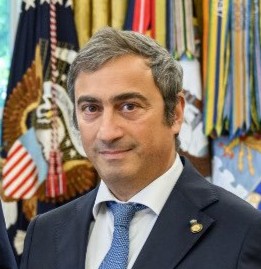
Peronaci, 60, graduated in political science from Sapienza University in Rome. He earned a master’s degree from the Italian Society for International Organizations and joined the Italian Foreign Service in 1988. After completing his military service was posted to his first overseas assignment in 1991 at the Italian Embassy in Kampala, Uganda. He also served at his country’s embassies in Tokyo and Paris.
The diplomat—who speaks English, French, Spanish and Japanese—was first counselor at Italy’s EU mission in Brussels, diplomatic advisor to the minister of justice, and ambassador in Brussels. Peronaci has also served as the Italian Foreign Ministry’s special envoy for Brexit as well as Italy’s Brussels-based permanent representative to NATO.
Meanwhile, Jens Hanefeld, a career diplomat and former lobbyist for Volkswagen, has replaced Andreas Michaelis as Germany’s ambassador to the United States.
Hanefeld studied modern history and English at the Freie Universität Berlin, graduating with a master’s degree in 1990. He was then posted to Bulgaria (1994-97) and later Washington (1997-2000). After increasingly senior positions at the Federal Foreign Office in Berlin, Hanefeld returned to Washington as minister and deputy chief of mission.
Hanefeld then took a 10-year leave of absence to work for VW as senior VP for international, European and trade policy. In 2024, he became Germany’s ambassador to Ethiopia and permanent representative to the Addis Ababa-based African Union.
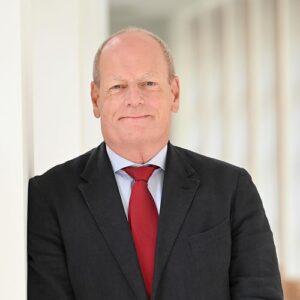
In an article posted by the American-German Institute, Frederik Fink said Hanefeld’s choice as an ambassador came as a surprise within government circles.
“For Chancellor [Friedrich] Merz, Hanefeld’s decade-long experience as a senior executive at Volkswagen may have been a key factor—particularly given that Merz himself has a background bridging politics and the private sector,” Fink wrote. “Hanefeld will represent Germany at a time when American retrenchment and remaking of the international trade system are colliding with Berlin’s and the EU’s efforts to uphold the rules-based international order.”
Fink added: “At the same time, Washington and Brussels remain out of sync on imposing further costs on Russia for its war in Ukraine and failure to engage in serious peace talks. In this context, appointing an ambassador with such long experience in Washington and such a deep understanding of one of Germany’s key industries from the inside could be just what the bilateral relationship needs.”
Ex-Soviet republics Lithuania, Moldova send new diplomats to DC
Further to the east is fellow EU member Lithuania, which 35 years ago became the first Soviet republic to declare independence from the collapsing USSR. That country’s new ambassador here is Gediminas Varvuolis, who recently replaced Audra Plepyté in the position.
Varvuolis, 55, has a bachelor’s degree in history studies from Vilnius University, and a master’s degree from Sciences Po in Paris. A married father of two, Varvuolis—like Italy’s Peronaci—speaks French, Spanish and Japanese, as well as Russian, Polish and Dutch.
He began his diplomatic career in 1995 as third secretary in the Lithuanian Foreign Ministry’s Western European Countries Division, serving in that post until 1998. Other posts followed, including first secretary at the Lithuanian Embassy in Paris, first secretary of the NATO Integration Division, and head of the Foreign Ministry’s Threat Analysis, Crisis Management and International Operations Division.
Varvuolis has also served as deputy head of Lithuania’s NATO mission in Brussels, and as ambassador to Belgium and later Japan.
At his White House swearing-in ceremony, Varvuolis thanked Trump for strengthening NATO in the face of unprecedented Russian missile attacks on Ukraine as well as recent Russian drone incursions in Poland and Romania.
“The presence of US troops in our country is a clear sign that no aggression will go unanswered. We are grateful to the United States and to you, President Trump, for this,” he said, noting Lithuania’s commitment to spend over 5% of its GPD on defense starting next year.
During the long period of Soviet occupation, said Varvuolis, Washington’s decision to recognize his country’s sovereignty became a beacon of hope for hundreds of thousands of Lithuanians.
“Therefore, today we must unconditionally support Ukraine, which loves freedom and is fighting for its survival,” he said. “As I look forward to my tenure in Washington, I also take exceptional pride in the great Lithuanian-American community that stands as a vital bridge between our great countries, linking generations, ideals and aspirations across the Atlantic.”
Fellow ex-Soviet republic Moldova also has a new ambassador: Vladislav Kulminski.
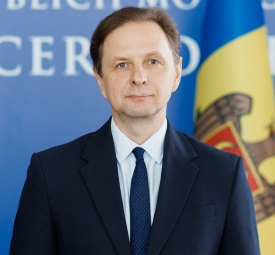
Considered an expert in foreign policy and national security, Kulminski, 52, has worked with the UN Development Program, Germany’s Gesellschaft für Internationale Zusammenarbeit, Humanitarian Dialogue and other international agencies. He helped implement the Black Sea Grain Initiative and has contributed to reform, social cohesion and peace-building programs throughout Eurasia, with a specific focus on Belarus, Ukraine and Turkey.
Kulminski was previously secretary of state for the Ministry of Foreign Affairs and European Integration. He was also named a member of the Supreme Security Council in January 2021. Later that year, he was named deputy prime minister at the Bureau of Reintegration—a body dealing specifically with Transnistria, a self-declared breakaway republic under Russian control.
Besides heading the Institute for Strategic Initiatives, Kulminski has also advised the World Bank on issues related to Moldova.
New Asian envoys from Bangladesh, Laos, Papua New Guinea
With 175 million people, Bangladesh ranks eighth in population globally, yet it’s not much bigger than Iowa. Dhaka’s new ambassador in Washington is Tareq Md Ariful Islam.
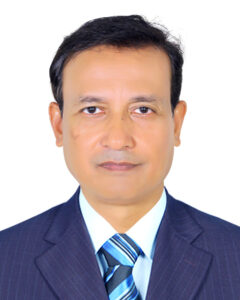
Formerly his country’s permanent representative to the United Nations in Geneva, Ariful Islam—a career diplomat—joined the foreign service in 1998. His previous postings include New York, India and Sri Lanka.
Laos is one of the world’s five remaining communist states, along with China, Cuba, North Korea and Vietnam. Its new ambassador in Washington, Phoukhong Sisoulath, said at his swearing-in ceremony that Laos appreciates US assistance provided under the 2016 Comprehensive Cooperation Framework in the areas of unexploded ordnance clearance, education and training, health, and law enforcement.
Trump responded that he “highly values” the 70 years of US-Lao diplomatic relations and expressed gratitude to the Lao government for cooperating in the search for American soldiers missing in Laos during the Vietnam War.
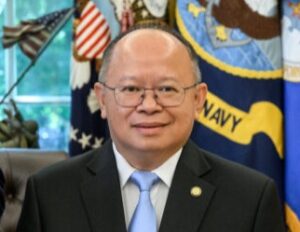
Arnold Amet is the new envoy from Papua New Guinea (PNG), home to 12 million people.
Amet, 72, is a former chief justice and governor of PNG’s Madang province. He attended high school in Australia and graduated in 1975 with a law degree from the University of Papua New Guinea. Named public solicitor in 1982 and a supreme court judge the following year, Amet was made chief justice in 1993—at the age of 40—for a 10-year term.
In 2007, he won election as governor of his home province, Madang, running on the National Alliance ticket. For a brief period, Amet was the country’s minister of justice and attorney-general, until the ruling party was brought down in a 2011 no-confidence vote.
Amet, who has served as a visiting justice in the courts of Fiji, Vanuatu and the Solomon Islands, briefly entered politics again in 2021 as a candidate for the Allegiance Party, but failed to secure a seat in parliament. He’s also been active in environmental issues and was a human rights monitor in Fiji following a 2000 military coup.
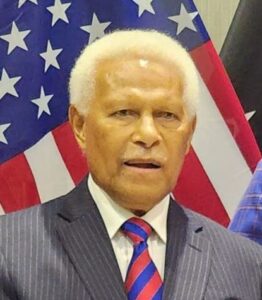
Lebanon, which has seen no shortage of political violence, finally has a new ambassador in Washington. Nada Hamadeh, filling a post that had long been vacant, has a bachelor’s degree in business administration from the American University of Beirut, as well as a master’s degree in finance from the George Washington University School of Business.
Most recently, Hamadeh was co-founder, managing director and chief financial officer of M Medical Group, a private-equity-backed healthcare firm. Before that, she spent 20 years with the World Bank, and before that, she worked for the UN on economic development initiatives across the Middle East and North Africa. Early in her career, she assisted Lebanon’s prime minister on postwar economic recovery, promoting foreign investment.
Hamadeh, who’s fluent in English, French, Arabic and Spanish, remains a board member of the Middle East Institute, the René Moawad Foundation and the American Task Force on Lebanon.
Paraguay and Uruguay: Don’t mix them up
Finally, in South America, founding Mercosur member nations Uruguay and Paraguay both have new ambassadors to the United States. But because they’re both relatively small and because their names are similar, the two countries are frequently confused.
Uruguay, with 3.2 inhabitants, has a long tradition of democracy and stability. Career diplomat Daniel Castillos, its new ambassador here, has a law degree from Uruguay’s Universidad de la República, and is a graduate of the Diplomatic Academy (IASE) in Montevideo. He’s also pursued postgraduate studies in international relations at England’s Oxford University.
Castillos’ earlier postings include assignments at Uruguayan embassies in Argentina and Switzerland. He was deputy chief of mission at the Uruguayan Embassy in Madrid as well as ambassador to South Africa. Before his current posting, Castillos was ambassador to Russia, with concurrent accreditation to Belarus, Kazakhstan and Uzbekistan.
Castillos is fluent in English and French, and has working knowledge of Portuguese and Italian. He and his wife, Eleonora Rodríguez, have four children.
Foreign Minister Mario Lubetkin said Castillos will be a key part of the government’s “pragmatic” strategy to engage with global powers. The move seeks to help Uruguayan President Yamandú Orsi better understand the direction of the Trump administration, which Lubetkin admitted he found unpredictable.
“Ambassador Castillos will serve for a period that we need to fully understand the trends in President Trump’s policy,” Lubetkin explained.
Paraguay, a landlocked nation of 7 million about the size of California, has long been plagued by poverty and corruption. From 1954 to 1989, it was ruled by Gen. Alfredo Stroessner, one of Latin America’s most infamous dictators.
The country’s new ambassador in Washington is businessman and lawmaker Gustavo Leite Gusinsky, 63. He’s affiliated with Cartismo, the political faction within the ruling Colorado Party of President Santiago Peña led by former President Horacio Cartes.
Leite studied business administration at the University of California-Irvine, majoring in finance, and also at California’s Chapman University. He earned a master’s in international marketing from the University of Strathclyde in Glasgow, Scotland.
During the presidency of Raúl Cubas Grau, Leite was Paraguay’s planning minister. And in 2013, he became minister of industry and commerce under Cartes. Since 2023, Leite has been serving as a senator.
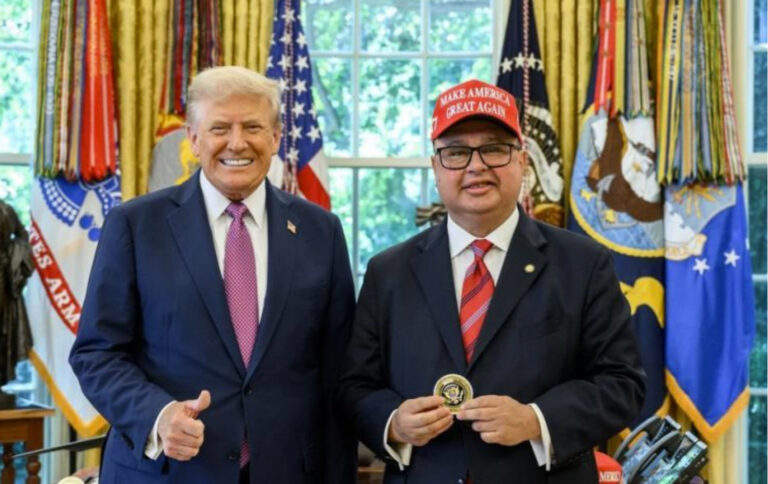
Following his credentialing ceremony—during which he wore a Trump trademark “Make America Great Again” cap—Leite told reporters: “President Trump was very kind in listening to me and giving me his position on several important points.” He added that both countries need to work as allies to achieve “tangible results in improving the lives” of their citizens.
