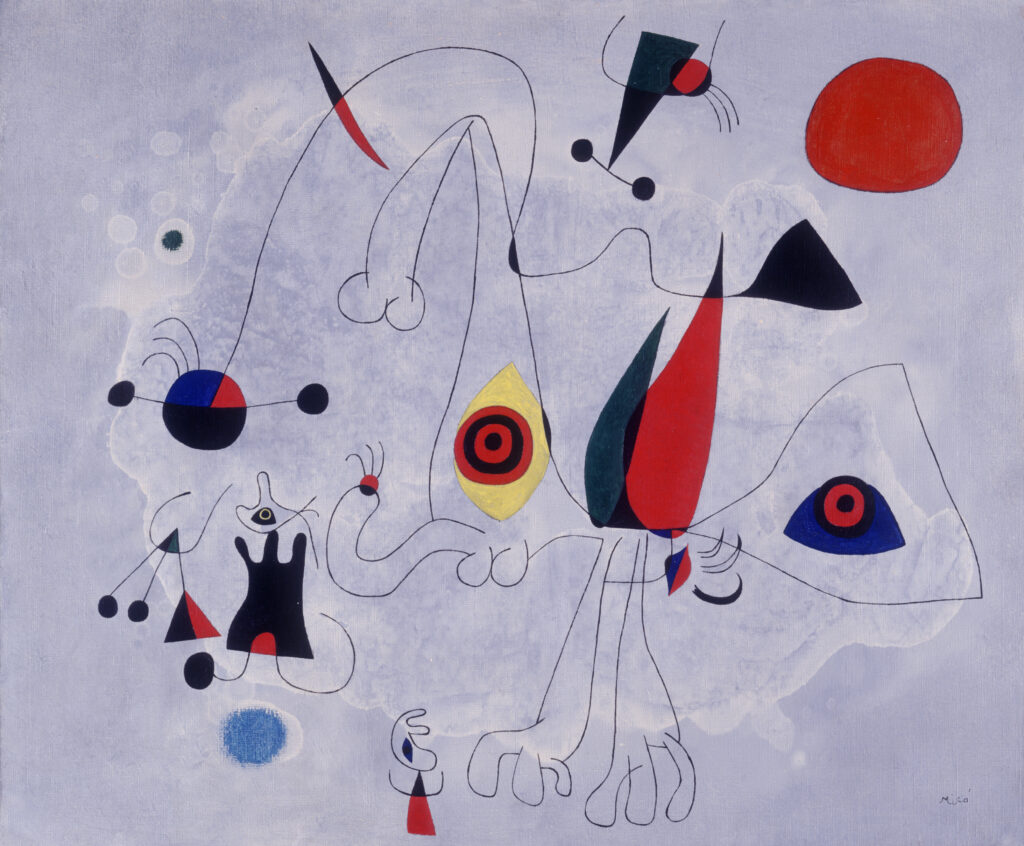
Bold black lines, floating red orbs and luminous bursts of yellow light dominate the Phillips Collection’s new exhibition celebrating Joan Miró and the American artists he influenced — and who, in turn, influenced him.
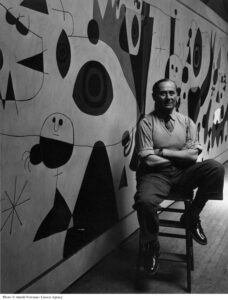
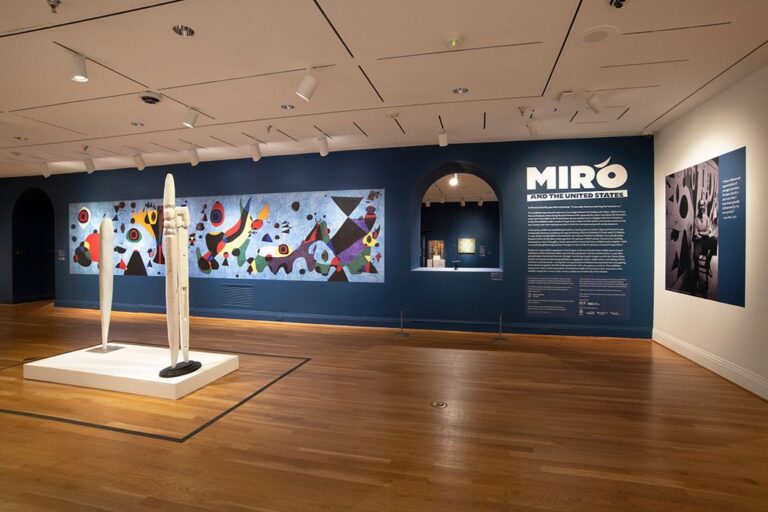
“Miró and the United States” invites visitors to delve deeply into the transatlantic exchange that shaped the artist and his contemporaries. Miró traveled to the United States seven times between 1947 and 1968, and the new works and connections that stemmed from this time serve as the core of this exhibition. About 75 works are on view, pairing Miró with more than 30 American artists. The show traces the creative dialogue that emerged from these cross-cultural encounters and stimulated such fascinating and atmospheric imagery.
The exhibition is a joy to wander through. There are sculptures by Alexander Calder, Miró’s lifelong friend, who opens the exhibition with a sparse and distinctive wire portrait of the artist from the Fundació Joan Miró in Barcelona (where this exhibition was first shown). There are stunning paintings from two generations of Abstract Expressionists to enjoy and meditate on, alongside an array of archival material that deepen the context. What’s on display encourages visitors to contemplate what it means to inspire and be inspired, and to see Miró’s career in a transatlantic light.
“Miró and the United States reframes Miró’s legacy by tracing the exchanges his work ignited with a rising generation of American artists — encounters that accelerated modern art on both sides of the Atlantic,” Elsa Smithgall, chief curator at The Phillips Collection, said in a statement. “The exhibition is a glowing testament to the vitality of transnational exchange as a driver for experimentation in contemporary art.”
The show makes for a dreamlike experience, with kaleidoscopic colors and strange senses of scale throughout. A massive foot hovers on an empty shore in the 1926 work, Person Throwing a Stone at a Bird. The painting reportedly deeply confused Americans who saw it at Miró’s first museum retrospective in the U.S. in 1941, and it’s a joy today to revel in its bizarre distortions. The wall text features a quote from the artist that speaks to his delight in this: “Isn’t it the foot that allows man to make contact with the earth? And there’s irony in it, too. We talk about putting our foot in our mouth.”
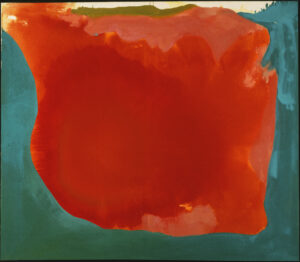
Helen Frankenthaler’s Canyon from 1965, all lush reds and oranges that strike a rich verdant green, echo Miró’s red orbs in a grandiose fashion. Frankenthaler and her husband, fellow Abstract Expressionist painter Robert Motherwell, acquired works by Miró for their collection, and The Phillips Collection notes that she hung reproductions of his art in her own studio. It’s fascinating to see the ways these artists spoke to each other across the canvas, exchanging ideas and methods, and this connection feels particularly convincing.
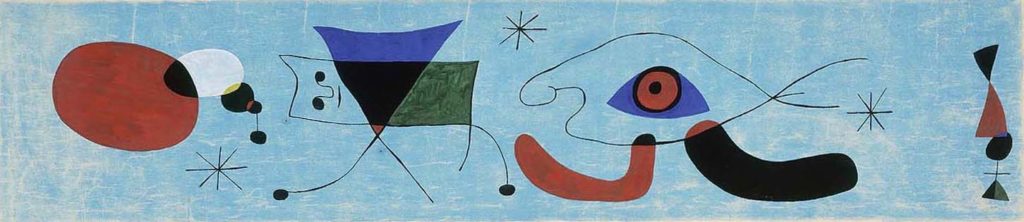
The Constellations room is unmissable, with 22 pochoirs on paper from his 1959 series. Inspired by the night sky, water, and music, the hand-stenciled prints carry such whimsy and beauty that you could spend an afternoon here alone. Miró began the series in Varengeville, France before fleeing the German invasion, and then finished his works in Palma de Mallorca and Montroig, Spain. They were first shown in 1945 at Pierre Matisse Gallery in New York, with all 22 pieces sold, the museum notes, in an early sign of their impact.
The artist Lee Krasner, whose work can be found in this exhibition, called each piece “a little miracle.” The geometric designs pop with blues, yellows and greens as stark black lines trace throughout each print. And don’t forget to look at the titles, which include such gems as Woman at the Edge of a Lake Made Iridescent by the Passage of a Swan and People at Night Guided by the Phosphorescent Tracks of Snails.
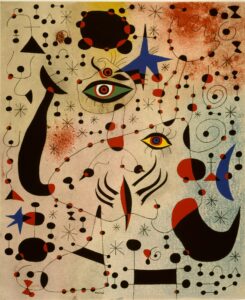
This series’ influence is unmistakable throughout the show. Take Rufino Tamayo’s Heavenly Bodies. The work by Tamayo, who likely saw the 1945 exhibition, uses oil and sand on canvas, its deep blue light split by streaks of white lines traveling across the sky. Then there’s Krasner’s Untitled [Little Image Painting] in conversation with Constellations, all thick paint and pops of color that explode like stained glass. She famously called herself “mad for Miró.”
Or take the American painter Barnett Newman, a major force of abstract expressionism, who said after seeing Constellations that “Miró is the pioneer in a new field that will change the face of art for many years to come.” Stand before his wondrous “Pagan Void” from 1946 and stare into the dark circle at its core. Let your eye wander out, where deep blues, greens and pale white shapes try to push against and out of the void’s realm. The work is dynamic and strange and it, like the works from Tamayo and Krasner, speaks to the entire thesis of the exhibition brilliantly.
The wall text at the start of the exhibition quotes Miró at the end of his life: “It was really American painting that inspired me.” The exhibition makes a compelling case for that, and the reciprocal influence of his work on scores of American artists. The show throws visitors from the delicate to the dramatic and the composed and contained to utter wildness. It’s lush and striking, with unexpected connections that reward your attention.
“Miró and the United States” runs through July 5.
All photos courtesy of The Phillips Collection.