
Morocco has believed in the United States since 1777
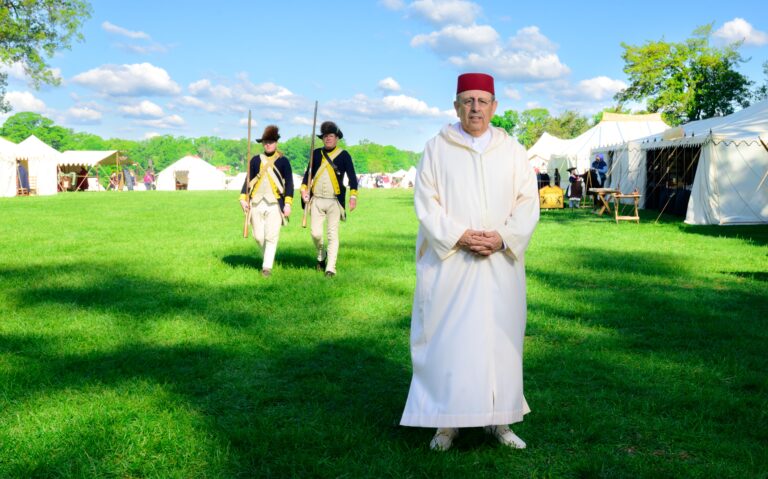
The photograph almost tells the story by itself. Youssef Amrani, Morocco’s ambassador to the United States, stands at Mount Vernon in a white djellaba and red fez, a striking contrast against the backdrop of men in Continental Army uniforms—bearskin caps on their heads, muskets at their sides. Though the image is staged, the history that inspired it is entirely real. Morocco was the world’s first nation to recognize the United States of America.
In December 1777—before the Revolutionary War had been won, before the Constitution had been written, before American power was anything more than ambition —Morocco’s Sultan Mohammed III issued a decree opening Moroccan ports to US ships. It was a quiet signal to the world that he believed the young republic deserved a place among nations. Yet, the Revolutionary War was underway, France had not formally entered the conflict, and the United States had existed for barely a year. There was no guarantee the Sultan’s bet would pay off.
“That early act of vision and trust laid the foundation for a relationship unlike any other,” Ambassador Amrani said in a recent speech. “For 250 years, our two nations consistently chose cooperation over distance, and trust over uncertainty.”
The formal architecture of the relationship came nine years later. The 1786 Treaty of Peace and Friendship—negotiated by American diplomat Thomas Barclay and his Moroccan counterpart at the Sultan’s court, and signed by Thomas Jefferson and John Adams—was the first treaty between the United States and any Arab, Muslim or African nation. In its renewed form, it remains the longest unbroken treaty in US history.
Amrani recently led a Moroccan delegation to the National Archives in Washington to view the original document. As he wrote afterward, it “was not simply an artifact behind glass.” It was evidence that the relationship between the two nations “began with a decision made before American power was assured.”
Ever since then, both sides have largely honored the relationship despite tremendous national and global changes. During World War II, Morocco became strategically vital to the Allied cause. Operation Torch landed on its shores and Casablanca hosted Franklin D. Roosevelt’s and Winston Churchill’s pivotal 1943 conference, where Roosevelt privately expressed support for Moroccan independence. When that independence came in 1956, Washington recognized it promptly, and the two countries deepened their partnership. As Amrani wrote in a recent essay, “very few diplomatic ties endure across centuries. Fewer still remain strategically relevant.”
In Washington this spring, acting on instructions from Moroccan King Mohammed VI, Amrani’s delegation concluded a new 10-year Defense Cooperation Roadmap, expanding collaboration in cybersecurity, advanced technologies and operational integration through 2036. Morocco now hosts African Lion—the US Africa Command’s largest annual military exercise on the continent—and the Pentagon is establishing Africa’s first permanent drone training hub on Moroccan soil.
“Two hundred and fifty years ago, our journey began with courage and foresight,” Amrani said in a recent speech for the America 250 International Series. “Today, it continues with clarity, strength, and an unwavering commitment.”
Standing at Mount Vernon, surrounded by the pageantry of America’s founding moment, Amrani is a living symbol, connecting an 18th-century alliance to a 21st-century partnership. The photograph makes the history visible in a single frame: a Sultan’s bold decision 250 years ago sparked one of diplomacy’s most enduring relationships.
—
This article was originally published in our 2026 Embassy Directory. Get your copy here.
