
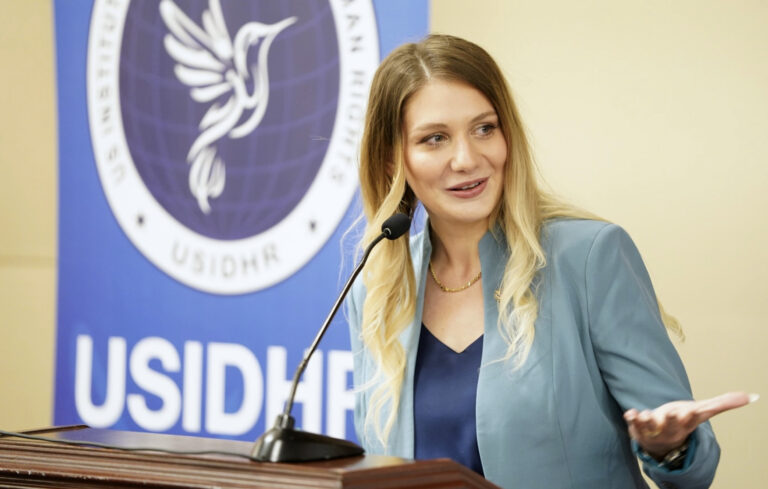
Isabelle Vladoiu knows painfully well what happens when a dictatorship abuses its people.
Born in Romania in the aftermath of the December 1989 overthrow and execution of Nicolae Ceaușescu, Vladoiu was raised by her grandparents, who had suffered nearly half a century of Ceaușescu’s iron-fisted rule.
Her hometown of Pitești—a small town northwest of Bucharest—was known among other things for a horrific prison where, for a time, violence among political detainees was mandatory. The controversial brainwashing program, which lasted throughout much of the 1950s, aimed to psychologically destroy any remnant of individual thinking.
“As soon as communism collapsed, my parents left. My father went to Spain, and my mother to Serbia—but I could still feel the influence of that regime,” she said. “When I was 6 years old, I saw an orange for the first time in my life. I was of the generation that witnessed the creation of a democratic country.”
Vladoiu ended up going to law school in Bucharest, then moved to the United States in 2015. She attended Buffalo University in upstate New York, earning two masters degrees in international and human rights law, as well as a doctorate from American Military University.
“I believe you have to be educated to get out of this environment and become someone,” she said. “For the past decade, I’ve been working in diplomacy, applying the principle of diplomatic protocol and etiquette to my own career in human rights.”
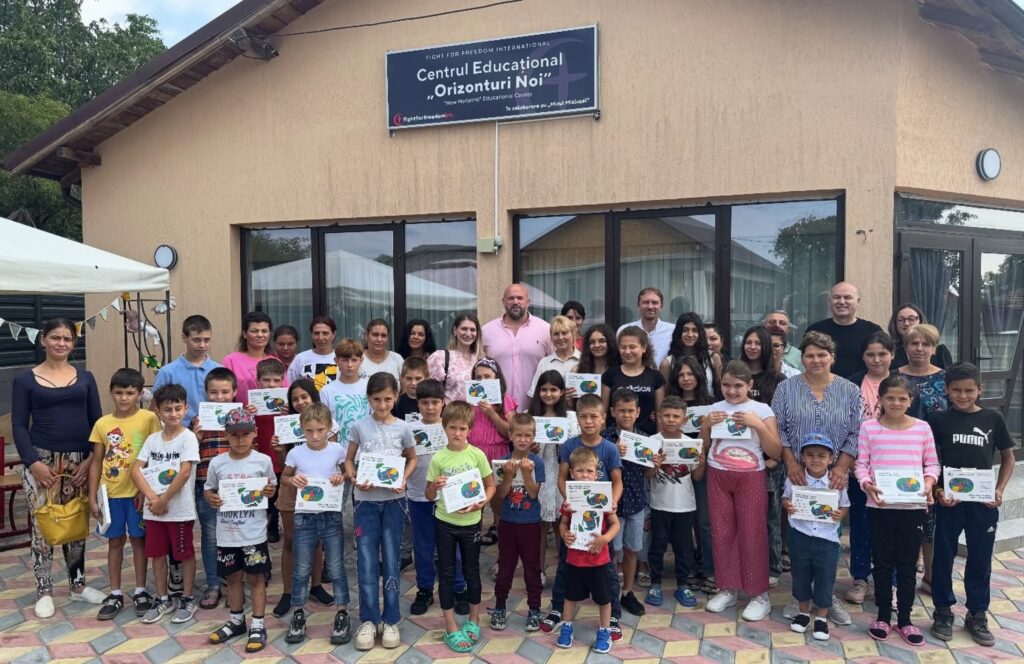
In 2019, Vladoiu inaugurated her own think tank, the US Institute of Diplomacy and Human Rights (USIDHR). Headquartered just off Dupont Circle along Connecticut Avenue, its core mission is “to advance education for all, and empower people to learn and understand human rights and diplomacy.”
In addition, USIDHR provides access to schools for underprivileged children by offering them resources such as school supplies and scholarships.
“We teach people about human rights from the perspective of becoming advocates, not activists. Their role is to help governments and companies implements human rights policies,” she said.
Among USIDHR’s focus areas: corporate sustainability and responsibility; education and capacity building; diplomacy and international engagement; and policy and research. Its online and in-person courses offer accreditation in fields ranging from prevention of human trafficking to religious freedom in the workplace.
Along the way, Vladoiu was honored by two presidents: the first time, in 2018, by Donald Trump for a President’s Volunteer Service Award, and again in 2022, by Joe Biden, for a Lifetime Achievement Award. In April 2024, DC Mayor Muriel Bowser commended Vladoiu during a ceremony for her Let Her Lead initiative, which helps young women and girls combat human trafficking, gender-based violence and child marriage.
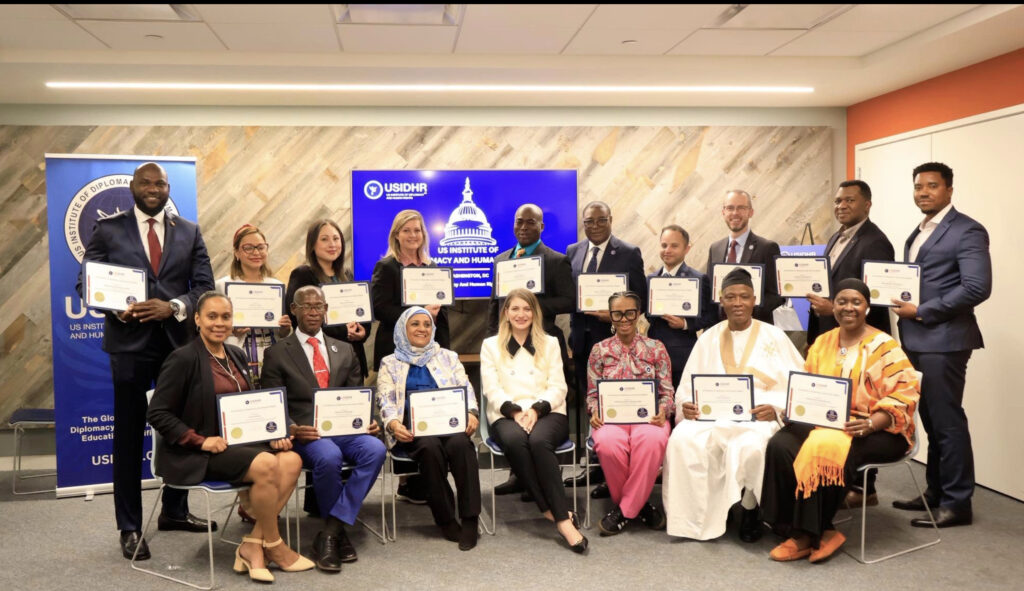
Today, USIDHR is active in 135 countries, and has certified more than 20,000 human rights consultants. In 2024 alone, it welcomed over 2,100 new consultants in half a dozen countries from Canada to Congo, from Pakistan to the Philippines.
Three times a year, Vladoiu hosts a three-day International Business and Diplomatic Protocol Training at USIDHR headquarters. The next one is scheduled for Sept. 17-19, 2025.
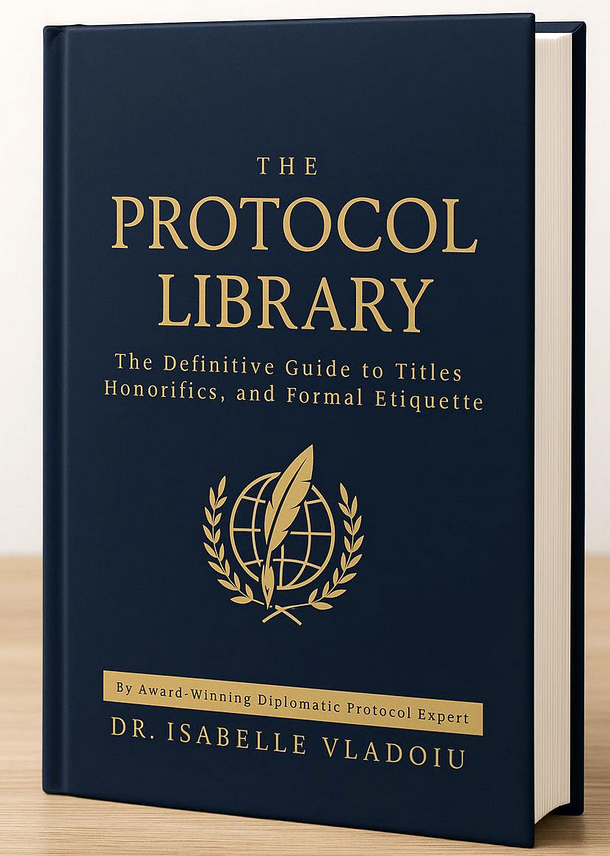
Vladoiu’s latest project is a 170-page reference. The Protocol Library: The Definitive Guide to Titles, Honorifics, and Formal Etiquette is just that—an encyclopedia of useful knowledge.
Available through Amazon at $49.99 per copy, the hardcover volume represents three years of meticulous work on Vladiou’s part and includes more than 100 official titles and forms of address; verified definitions from legal, religious and diplomatic sources, and instant QR access to exclusive online materials.
“I created this book as a tool that everyone can have in their personal or professional libraries,” she said. “You can grab it and instantly find the information you need. For example, if you’re about to meet an ambassador or you want to write a letter to an ambassador, how do you address that person?”
Vladoiu said nobody has ever put together such a reference. The intended market includes business leaders, diplomats, event managers, protocol officers, NGOs, ceremonial leaders and anyone else who deals with diplomatic protocol.
This is Vladoiu’s third book. She said her previous works—Business Etiquette Secrets: The Fast Track to Professional Authority and How to Become a Human Rights Professional: A Guide to Human Rights Advocacy—have sold over 30,000 copies.
“I had many disadvantages as a young woman in circles that included only men, so I wanted to use this knowledge in my personal life,” she said. “Even when writing emails, there’s a technique of how to do it. Let’s say I want to invite an ambassador to speak at one of my events. It makes a difference how you address them. They’ll know if you really applied diplomatic protocol, and that increases your chances of approval. It also makes you stand out.”
