
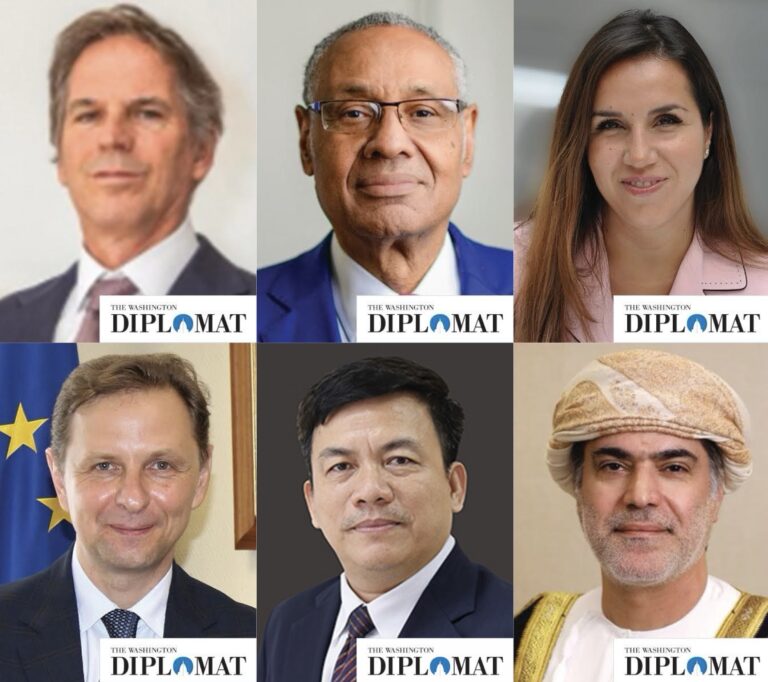
The latest crop of 14 new ambassadors in Washington includes diplomats from two former Soviet republics, two Caribbean nations, three African countries and three Arab ones.
The biggest of these 14 countries by size is Argentina, the world’s eighth-largest country in area, with 45 million people spread across its 2.78 million sq km. In 1913—on the cusp of World War I—Argentina also ranked among the 10 richest countries in per-capita income thanks to agriculture exports, yet its economy began crumbling in the 1930s.
In its history, Argentina has defaulted on its debt nine times, most recently in 2014 and 2020. But Argentine President Javier Milei, a right-wing libertarian who’s been in office since December 2023, has managed to turn the economy around. Inflation has plummeted from 143% to below 30%, thanks to the lifting of currency controls, and GDP will likely grow by 5.2% in 2025.
It should come as no surprise that Alejandro “Alec” Oxenford, Argentina’s new envoy in Washington, is a businessman. So was his predecessor, Gerardo Werthein, who held that same job for only half a year before Milei named him foreign minister. Oxenford, 56, now reports directly to Werthein.
“Thank you very much for your trust, President Javier Milei. I am convinced that, with focus and dedication, we will achieve significant impact, better positioning Argentina in the US and the world,” Oxenford wrote on X minutes after his nomination. He also said he was honored to have Werthein “as a guide” and Milei as an “inspiration.”
Oxenford is a well-known entrepreneur, investor and arts patron with an MBA from Harvard Business School as well as a bachelor’s degree in business administration from Catholic University of Argentina. He has no prior diplomatic experience.
In 2014, Fortune magazine called Oxenford a “CEO rock star of sorts” in South America. Among other things, the executive, who’s fluent in Spanish, English and Portuguese, founded the eCommerce platform DeRemate—which was later sold to eBay—as well as New York-based OLX targeting Brazil, India and Eastern Europe, and letgo, a mobile classified ad app for the US market.
Before his tech ventures, Oxenford was a senior executive with Boston Consulting Group. He supports Argentine artists and institutions through the Oxenford Collection. Among other things, he belongs to the Argentine President’s Advisory Council and the Economic Advisory Council at Torcuato Di Tella University; he also sits on the board of Endeavor Argentina.
The Democratic Republic of Congo, Africa’s second-largest country (after Algeria), is home to 113 million people. It also has a newly appointed, but not yet confirmed, ambassador here: Yvette Ngandu Kapinga. In choosing her, President Félix Tshisekedi is “betting on a seasoned operator,” reports the website Bankable.
Educated at Ohio’s Bowling Green State University, Ngandu has degrees in public administration and international relations. She spent more than 20 years in diplomacy, governance and peacebuilding, and was formerly the African Union’s representative in New York; she has also worked with the National Endowment for Democracy, the African Union Commission in Addis Ababa, Ethiopia, and the US State Department.
“The timing is anything but casual. US-Congo relations are entering a complicated stretch,” the website reported, noting recently concluded peace talks by the Trump administration betweeen Congo and neighboring Rwanda.
“At the same time, Washington is negotiating access to Congo’s coveted supply of strategic minerals—the kind used in electric vehicles, smartphones, and missiles,” it said. “Meanwhile, a cloud is forming over Congo’s immigration status. On June 14, US officials issued a 60-day warning to 36 countries, including the DRC, threatening travel bans unless they tighten up identity documents and crack down on fraud.”
Haiti, one of the world’s poorest countries, also has a new ambassador in town: Lionel Delatour.
His appointment comes at a critical time for this Caribbean nation, which shares the island of Hispaniola with its far more prosperous neighbor, the Dominican Republic.
On June 28, the US Department of Homeland Security warned it would terminate Temporary Protected Status (TPS) for some 500,000 Haitians legally in the United States effective Sept. 2, on the grounds that “conditions in Haiti no longer meet the TPS statutory requirements.” The decision, by DHS Secretary Kristi Noem, effectively puts those refugees at risk of deportation back to a country riddled with gang violence and extreme lawlessness.
In fact, the State Department’s own website warns Americans not to travel there due to the risk of “kidnapping, crime, civil unrest and limited health care.”
Whether Delatour will be able to make a difference as ambassador remains to be seen, though his credentials appear to be impressive.
A recognized expert in US-Haiti bilateral relations, the 74-year-old Delatour earned a bachelor’s degree from Georgetown University’s School of Foreign Service, and a master’s in public administration from Harvard’s Kennedy School of Government. He served at Haiti’s embassy here from 1979 to 1988.
Following the 1991 coup d’etat against then-President Jean-Bertrand Aristide, Delatour began his career as a political analyst.
As a consultant to the Association des Industries d’Haïti (ADIH), Delatour played a pivotal role in passage of the Haiti Hemispheric Opportunity through Partnership Encouragement (HOPE) Act in 2006, HOPE II (2008) and the Haiti Economic Lift Program (HELP) in 2010, as well as advocating for the renewal of HOPE/HELP in 2015 and the Caribbean Basin Trade Partnership Act (CBTPA) in 2020.
Delatour, a founding member and past-president of the Centre pour la Libre Entreprise et la Démocracie, says his mission as ambassador is “to mobilize greater support for Haiti’s urgent priorities, including national security, humanitarian assistance, economic recovery, diaspora engagement and migration.”
Yet another deeply troubled country with a new ambassador is Lebanon—once a model of Middle East prosperity that now suffers one of the worst economies in the Arab world.
Nada Hamadeh, armed with a solid business background, has been appointed to fill the long-vacant post, following a June 19 announcement by President Joseph Aoun.
Hamadeh, 50, has a bachelor’s degree in business administration from the American University of Beirut (1995), and a master’s degree in finance from the George Washington University School of Business (2007).
Most recently, Hamadeh was co-founder, managing director and chief financial officer of M Medical Group, a private-equity-backed healthcare firm. Before that, she spent 20 years with the World Bank, first as a senior economist and international comparison program global lead (2003-19), then as lead economist and program manager (2019-22) and finally as manager (2022-23).
Before her tenure at the World Bank, Hamadeh worked for the United Nations on economic development initiatives across the Middle East and North Africa. Early in her career, she assisted Lebanon’s prime minister on postwar economic recovery, promoting foreign investment.
Hamadeh, who’s fluent in English, French, Arabic and Spanish, remains a board member of the Middle East Institute, the American Task Force on Lebanon, and the René Moawad Foundation which she runs with her philanthropist husband.
“I am committed to dedicating my full efforts to support Lebanon, and to strengthen the longstanding and historic relationship between Lebanon and the United States,” Hamadeh said in a statement issued upon her appointment. “I also look forward to working with the Lebanese diaspora in the United States, and to serving them with responsibility this appointment and my national duty require.”
Two former Soviet republics also have new DC-based ambassadors: Georgia and Moldova. Both countries aspire to join the European Union as well as NATO, and both fear a full-scale Russian invasion following the Kremlin’s unprovoked attack on Ukraine in February 2022.
Georgia’s Tamar Taliashvili—who has not yet been confirmed—and Moldova’s Vladislav Kulminski take up their posts in the midst of the Russia-Ukraine conflict, now in its third year.
Kulminski has worked with the United Nations Development Program, Germany’s Gesellschaft für Internationale Zusammenarbeit, Humanitarian Dialogue and other international agencies. Among other things, he helped implement the Black Sea Grain Initiative and has contributed to reform, social cohesion and peace-building programs throughout Eurasia, with a focus on Belarus, Ukraine and Turkey.
He’s also served as a political advisor to the US and British embassies in the Moldovan capital of Chișinău (formerly Kishinev).
Kulminski was previously secretary of state for the Ministry of Foreign Affairs and European Integration. He was also named a member of the Supreme Security Council in January 2021. Later that year, he was appointed deputy prime minister at the Bureau of Reintegration—a body dealing specifically with Transnistria, a self-declared breakaway republic under Russian control. Yet he soon quit that post, citing family reasons.
Besides heading the Institute for Strategic Initiatives, Kulminski has also advised the World Bank on issues related to Moldova.
Other new faces on Embassy Row include Koy Kuong of Cambodia; Maj. Gen. (Ret’d) Antony Anderson of Jamaica; Lok Darshan Regmi of Nepal; Talal Alrahbi of Oman; Abdoul Wahab Haidara of Senegal; Amara Sheikh Mohammed Sowa of Sierra Leone; Dragan Šutanovac of Serbia; and Abdulwahab Alhajiri of Yemen.
For a complete listing of all foreign ambassadors to the United States, please subscribe to the new 2025 Embassy Directory.
