
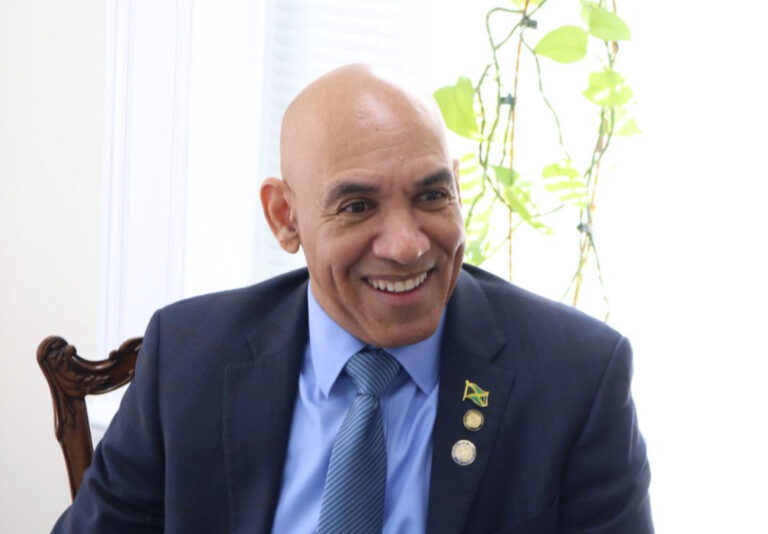
Maj. Gen. (Ret.) Antony Anderson had been on the job for exactly five months as Jamaica’s ambassador to the United States when his country suffered its worst natural disaster in history.
On Oct. 28, Hurricane Melissa—a Category 5 storm with sustained winds of 185 mph— came ashore at New Hope, about 90 miles west of Kingston, the capital. It produced the world’s highest wind gust ever measured, 252 mph, and tied the 1935 Labor Day Hurricane as the third-most intense Atlantic hurricane in history.
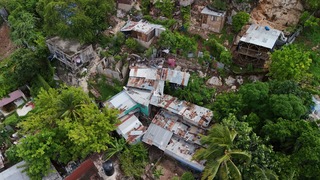
By the time slow-moving Melissa had drifted off Jamaica’s north shore and toward Cuba and later the Bahamas, this monster had already killed 58 people and caused nearly $9 billion in damage; it also left 43 dead in nearby Haiti.
“If there’s any upside to this, it’s that Melissa spared the eastern end of the island, and Kingston in particular,” said Anderson. “This storm was moving only 2 mph with winds gusting up to 220 mph. It also dumped 20 inches of rain on us.”
The only hurricanes that came anywhere close to Melissa in ferocity were Gilbert in 1988, and Charlie in 1951.
But Melissa was by far the costliest storm ever to strike Jamaica, according to the Miami Herald, citing figures by the World Bank in coordination with the Inter-American Development Bank (IDB). The estimated damage is equivalent to nearly half of Jamaica’s $20 billion GDP.
On Dec. 1, Jamaica secured up to $6.7 billion in international support over the next three years to fund reconstruction efforts, Reuters reported. That money will come from the World Bank, the IDB, the Caribbean Development Bank (CDB), the Development Bank of Latin America and the Caribbean (CAF) and the IMF.
Up to $3.6 billion of the package could be made available in sovereign financing for the government’s recovery and reconstruction program, said the institutions—including up to $1 billion each from CAF, the IDB and the World Bank, $200 million from the CDB, and a potential $415 million loan from IMF under its rapid financing window for natural disasters.
The institutions added that their divisions linked to the private-sector—IDB Invest, IFC and MIGA — are working to mobilize an initial $2.4 billion in private investment to also support reconstruction, Reuters said.
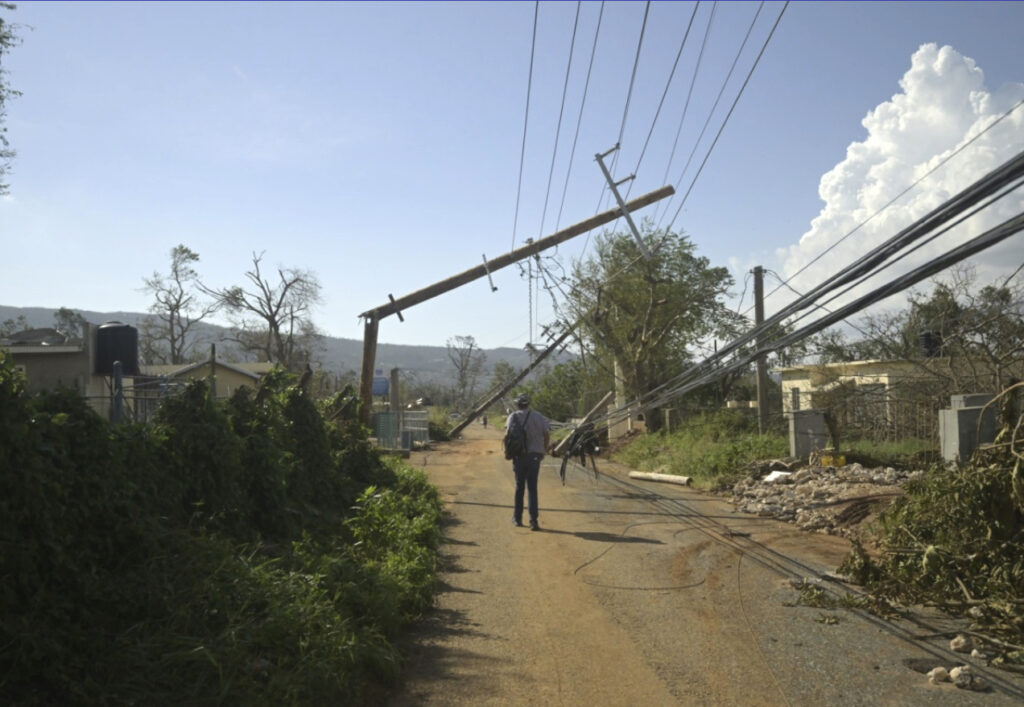
Melissa damaged or destroyed around 200,000 structures across the island. Agriculture was also hit hard, with crop damage alone estimated at $175 million, said Anderson, noting that western Jamaica “is the breadbasket of the country, especially cash crops.”
“We have to deal with that and get things back up and running,” Anderson told us. “The good news is that Jamaica is doing well in terms of economic development and stability. Our credit rating has gone up every year, and our debt-to-GDP—which in 2013 stood at 140%—is now at 62%. That massive reduction in debt has allowed us to reinvest in capital development and create the conditions for more investment.”
Envoy says military background has served him well
Anderson, 62, is a career military man. He spoke to the Washington Diplomat from his country’s embassy just off Dupont Circle—not only Melissa but also about drugs, violent crime, the US immigration crackdown and other issues plaguing the tropical island otherwise known for idyllic Caribbean vacations, reggae music and Blue Mountain coffee.
Anderson has a bachelor’s degree in engineering from England’s Cranfield University, and a master’s in defense administration from the Royal Military College of Science. His 35-year military career was capped by his tenure as chief of defense of the Jamaica Defence Force (2010-16), and later as the first-ever national security advisor to Jamaica’s prime minister (2016-18).
After that, Anderson was named commissioner of the Jamaica Constabulary Force (2018-24), during which time he modernized police operations through enhanced technology, organizational reform and improved public safety mechanisms. In fact, he’s long been instrumental in fostering regional cooperation, having led and advised on various multinational security operations throughout the Caribbean.
“Once you’re operating at the top level of the military, there’s lots of defense diplomacy involved,” said the ambassador, who was sworn into office on May 28, precisely five months before Melissa made landfall on Jamaica’s south coast. “You do a lot of work overseas. It doesn’t make you a complete stranger to diplomatic circles.”
Among his awards: Order of Distinction, Commander Class (2012); induction into the US Army Command and general Staff College International Hall of Fame (2017); the Queen’s Platinum Jubilee Medal (2022), and an honorary degree from Jamaica’s University of Technology (2024).
“You’re used to looking at global affairs, and you’re always aware of the diplomatic, military and economic paradigm,” he explained. “It’s always in the forefront of your mind, and you come to it having operated at a global, strategic level that will perhaps give me a particular view that may assist my own government.”
Ambassador: ‘Really strong’ US response after Melissa’s destruction
Asked to assess US-Jamaican relations, Anderson immediately replied: “Good. Really strong. You guys came down in a heartbeat after Melissa. The State Department worked with the Pentagon to get assets in through Task Force Bravo—three Chinooks and four or five Black Hawks supporting lift operations. We also got urban search-and-rescue teams out of Fairfax County, Va., and a team out of L.A., as well as DART [Disaster Assistance Response Team].”
In addition, he said, “we’ve gotten significant support from 41 other countries around the world, and also some of the largest relief agencies working collaboratively in Jamaica,” including Food for the Poor, Global Empowerment Mission, Samaritan’s Purse and World Central Kitchen.
Another group helping out is Right Now for Jamaica. It was formed as a Section 501(c)(3) nonprofit days after the hurricane by Ron McKay—a businessman who lived in Jamaica for 14 years and was president of the American Chamber of Commerce in Kingston from 2012 to 2018.
“During my 20 years in the region, we’ve worked very closely with public-private partnerships. And I really believe that given the devastation that has occurred, the private sector will be key to rebuilding,” said McKay, who’s worked in the tourism industry throughout the Caribbean.
“I’ve spoken to several experts involved with Katrina,” he said. “We’ve been very low-key, but so far we’ve put together a dream team from the private sector—successful diaspora business executives from the Beltway—to utilize technology and advance solutions to have impactful relief, not just for today but to make a transformational legacy for generations to come.”
Yet McKay said one big obstacle to Jamaica’s quick recovery is the Trump administration’s July 2025 elimination of the US Agency for International Development. The agency’s demise was warmly praised by Secretary of State Marco Rubio, even as a study published in The Lancet warned that USAID funding cuts could result in 14 million additional deaths by 2030, with nearly a third of those deaths among children under 5 years old.
“We don’t have USAID anymore. In the immediate term, this loss is immeasurable,” McKay told The Diplomat. “When I was president of AmCham, there was at least an organization to turn to that gave us some structure. That’s not there anymore, and it’s one reason we should bring it back. There must be something that provides this type of aid to our neighbors and friends.”
It’s also crucial to salvage the tourism industry, said McKay, noting that Jamaica was on track to receive five million tourists this year, most of them Americans.
“We can’t afford to lose the season,” he said, estimating that it’ll take the country at least two or three years to recover from Melissa’s wrath.
Drug smuggling, firearms and Jamaica’s spiral of violence
Melissa’s swath of destruction is not the only reason the Caribbean is making headlines these days. The Pentagon has killed at least 80 people under the Trump administration’s controversial policy of targeting suspected drug-smuggling on the high seas. On Nov. 29, the Washington Post —quoting two people with direct knowledge of the operation—reported that Defense Secretary Pete Hegseth had given a verbal order to kill everybody on such boats and leave no survivors.
Anderson refused to say what he thinks of the new policy. Instead, he cited a decree issued by the 15-member Caribbean Community (Caricom) stating that the Caribbean is a “zone of peace.”
“The majority of Caricom members agreed, including Trinidad & Tobago, and Jamaica hasn’t articulated one separately from the Caricom statement,” he said. “Sometimes, countries have their issues, but we try to take collaborative positions on many things.”
At any rate, said Anderson, drug traffickers look for the path of least resistance.
“This business goes in waves. It tends to find other routes, depending how hardened we are to that type of thing,” he said. “There was a time when you had a lot of transshipment through Jamaica. But through collaborative work, they extradited people who were the key players, and it dropped significantly after that. Every country has to invest in their own resources and systems to resist the threats that affect them—not only the drug issue, but also the associated gun issue.”
Guns and gangs largely explain why Jamaica has been so violent in recent years.
In 2023, according to the United Nations Office on Drugs and Crime, Jamaica recorded 1,400 homicides; that translates into a homicide rate of 49.3 per 100,000, the world’s highest (and just ahead of Ecuador, at 45.7, and Haiti, at 41.1). By comparison, Singapore—with twice the population of Jamaica— had only four murders that year.
Even so, crime is going down, he said, noting that Jamaica has only 70,000 registered private gun owners, and that 80% of the island’s homicides are committed with guns.
“There’s been a significant investment in police capability, training, infrastructure and intelligence, so it’s much harder for a criminal to escape,” he said, citing a 43% drop in homicide for the first five months of 2025 compared to the same period last year. “We’re making it difficult to commit crimes and get away with it. We’ve also changed the laws regarding firearms, so now it’s very hard to legally get a gun in Jamaica.”
Anderson said that despite Jamaica’s traditional reputation as a marijuana producer, ganga—unlike cocaine—was never associated with violence.
“For many years, gangs have and still contribute the most to violence,” he said. “Gangs are part of transnational crime. It doesn’t begin and end in Jamaica. These gangs traditionally have links to Colombia, but also the US and UK. The key is, your solutions have to be transnational, too.”
