
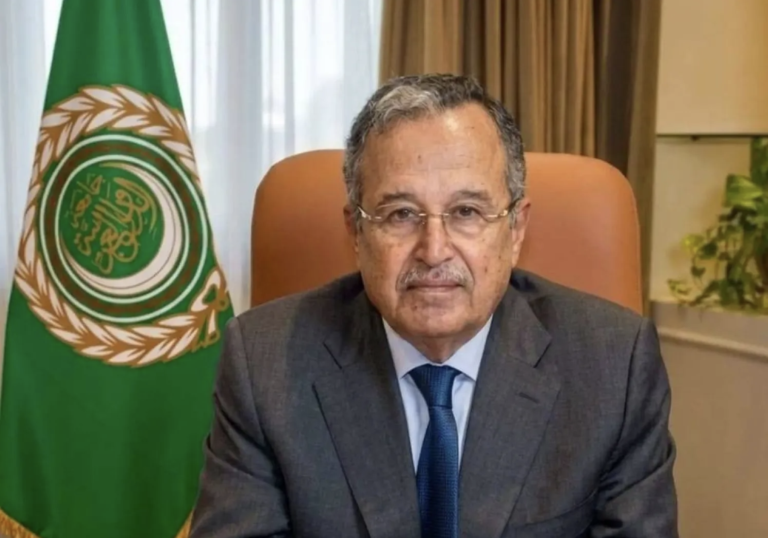
“The world order is in complete disorder,” with Arabs in grave danger of being left behind, warns one of Egypt’s most seasoned diplomats.
That’s the rather stark assessment made by Nabil Fahmy, 75, who served as Egypt’s ambassador to the United States from 1999 to 2008, and foreign minister from 2013 to 2014.
After his diplomatic service, Fahmy became founding dean of the School of Global Affairs and Public Policy at the American University in Cairo.
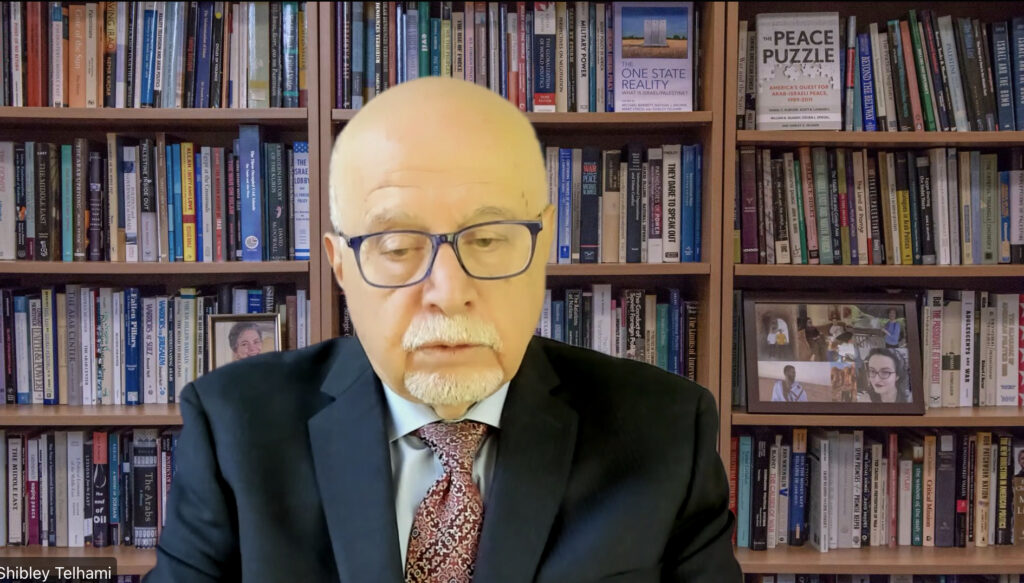
“There is no appreciation or even partial respect for international law. It’s all about the use of force rather than the force of law,” Fahmy said in a Sept. 14 online forum titled “The Arab World in Tumultuous Times” that was sponsored by the University of Maryland’s College of Behavioral and Social Sciences, and moderated by fellow academic Shibley Telhami, UMD’s Anwar Sadat professor for peace and development.
On July 1, Fahmy succeeded fellow Egyptian diplomat Ahmed Aboul Gheit as secretary-general of the League of Arab States—a regional bloc that stretches from Mauritania along West Africa’s Atlantic coast to Oman on the eastern tip of the Arabian Peninsula.
Collectively, the Arab League’s 22 member nations are home to more than half a billion people. The most populous of those is Egypt—which accounts for just under a quarter of that total. Yet for all its oil wealth and vast territory, the Arab world is losing ground on the international stage.
“We need to take charge of our own destiny. We cannot live in a region defined by others,” warned Fahmy, whose five-year term at the helm of the Arab League expires in 2031. “If we don’t embrace changes in the way we think, we will all be left behind.”
He added: “I’ve lived in the United States for a long time, and its politics are all based on the cost-benefit principle. Arabs need to understand that America will move only when it’s in its interests. Otherwise, don’t expect much from the Americans.”
Born and raised in New York, Fahmy is the son of the late Ismail Fahmy, who was President Anwar Sadat’s foreign minister from 1973 to 1977. The elder Fahmy resigned in 1977 to protest Sadat’s groundbreaking visit to Jerusalem—a visit that led to the historic Camp David peace treaty between Egypt and Israel, as well as to Sadat’s own assassination in 1981.
“Obviously you’re not a stranger to crises and turbulence,” Telhami reminded Fahmy, whom we profiled back in 2004 at the midpoint of his tenure as Egypt’s ambassador here. “I remember when you and I first met, in August 1990. You were then at the Egyptian mission to the UN. We were both dealing with the Iraqi invasion of Kuwait that had just taken place.
“Fast-forward to 1999. You came to Washington as Egypt’s ambassador to the US after having served as ambassador in Japan,” Telhami continued. “At the time, there was still hope for the Oslo Accords. Then came the horror of 9/11, which had many consequences—both for America and the Arab world.”
More than 25 years after 9/11, terrorism still defines much of US policy in the Middle East, though now, of course, the news cycle is dominated by Trump’s war against Iran and that country’s ongoing nuclear weapons program.
“I’m not going to support this war in any respect,” Fahmy declared. “The reality is that the JCPOA [Joint Comprehensive Plan of Action] was negotiated without consulting the Arabs—and I’ve complained about this,” he said, referring to the 2015 nuclear deal with Iran. “But America and the West, and the Russians and Chinese, all felt they didn’t have to ask us. They believe we’re too dependent on them. This has nothing to do with who’s in power in America.”
He added: “There was clearly no Arab agreement to go to war. Ultimately, the decision was made by America or Israel, or by both together.”
That war, as well as ongoing hostilities between Israel and Iran’s proxies in the Arab world—Hamas in Gaza, Hezbollah in Lebanon, and the Houthis in Yemen—have dominated the agenda for hundreds of millions of Arabs, and of course for the Israelis themselves.
But it has also endangered the inhabitants of countries that Iran has targeted with missiles and drones, including Saudi Arabia, Bahrain, Jordan, Oman, Qatar and the United Arab Emirates.
The war started after the Oct. 7, 2023, surprise attack by Hamas on Israel that killed more than 1,200 Jews and others. In response, Israel launched an air and ground invasion of Gaza that has left an estimated 73,000 people dead, according to the Hamas-run Ministry of Health.
Telhami himself is an Arab Christian who was born in a village outside the Israeli city of Haifa in 1951, three years after Israel’s establishment. He cited surveys showing that the vast majority of Arabs—and nearly 40% of American Jews—now believe Israel is guilty of genocide in Gaza.
Asked what the prospects are for a two-state solution, Fahmy was not optimistic.
“There’s no question that for people of my generation, the Palestinian issue has been a great disappointment. We have not given the Palestinians a secure, normal life. Whether it’s two states or one state, we have not succeeded,” Fahmy said, acknowledging, however, that “the Israelis are never going to feel secure as long as there’s conflict.”
The problem is that Israel itself has changed, with a dramatic shift to the far right in recent years, especially after Oct. 7.
“Our country was the first in the Arab world to sign a peace treaty with Israel, but even my generation now wonders, does Israel really want peace? You’d expect that after the Egyptian-Israeli peace agreement, that Israelis would move to the left,” he said.
But in fact, the opposite happened.
“Israel is today much farther to the right than when we signed the agreement, and when Jordan signed [in 1994]. With every step forward, Israel has moved further to the right.”
Although support for a two-state solution based on Israel’s pre-1967 borders is clearly fading on both sides, Fahmy insists that a one-state alternative “is not a solution at all,” but a formula for indefinite conflict.
“There will only be peace when Israel understands that you cannot have peace by force alone,” he said. “We will offer peace only if the occupation ends. I would argue that Arabs need to be even clearer on both the meaning of peace and the cost of its absence. This is how we can bring this thing to closure.”
