
Causes and consequences of an unintended revolution
People often think of the American Revolution as a specific event that unfolded in an orderly way, rushing inexorably toward the reality of an independent nation that was destined to grow into a strong and prosperous country.
But historians and political scientists who study and write about this era tell us this wasn’t the case. They argue that the American Revolution was a jumble of actions and responses, strategic plans and ad hoc adjustments, reasoned arguments and inflammatory rhetoric. It was an unpredictable and chaotic time in which the outcome was always in doubt.
“No event in American history which was so improbable at the time has seemed so inevitable in retrospect as the American Revolution,” writes historian Joseph Ellis. “What in retrospect has the look of a foreordained unfolding of God’s will was in reality an improvisational affair in which sheer chance, pure luck—both good and bad—and specific decisions made in the crucible of specific military and political crises determined the outcome.”
Ellis argues that the very term American Revolution “propagates a wholly fictional sense of national coherence not present at the moment, and only discernible in latent form by historians engaged in after-the-fact appraisals of how it could possibly have turned out so well.”
As the United States and others around the world prepare to celebrate the 250th anniversary of the Declaration of Independence, it is important to consider what happened, how the Revolution has been interpreted, and the legacy of this historical drama for America’s future.
While 1776 was the year in which leaders from the 13 colonies approved the majestic declaration confirmed the rupture between Americans and Britain, tensions had been building for more than a decade.
The British exercised mostly benign oversight of the colonies until 1765, and Americans enjoyed their considerable freedoms. Then the British Crown—mainly to deal with the large debt accrued during the Seven Years’ War with France— became more assertive. In a highly consequential decision, Britain in 1765 levied the Stamp Act, its first direct tax on the colonies. This provoked colonial anger, unrest and resistance.
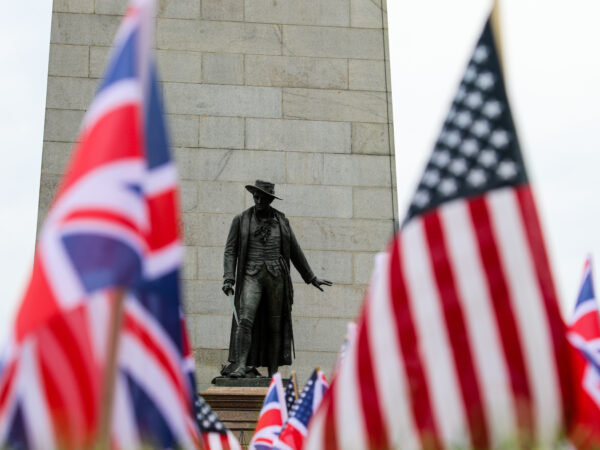
Thus began a decade of increasingly consequential developments that led to the outbreak of the Revolutionary War in 1775. These include the Townshend Acts of 1767, the Boston Massacre in 1770, the Boston Tea Party in 1773, the Coercive Acts in 1774, and the battles of Lexington and Concord in the spring of 1775 which ignited the war.
Rising tensions and public clashes spurred innovative ideas, wide-ranging discussions and heated debates among what historian Ellis calls the “most politically creative generation in American history.” He was referring to Thomas Jefferson, John Adams, James Madison, Benjamin Franklin, Alexander Hamilton, Thomas Paine and others.
In 1774, Jefferson drafted “A Summary View of the Rights of British America,” which was his first published statement of colonial grievances against King George III and the British government. Several months later, the First Continental Congress convened in Philadelphia and approved a petition to the King for the redress of these grievances.
The Second Continental Congress assembled in Philadelphia the following spring and approved a resolution after the outbreak of hostilities at Lexington and Concord. Written by Jefferson and John Dickinson, the “Declaration of the Causes and Necessity of Taking Up Arms” explained the colonists’ decision to resort to force. However, Congress also approved a petition of reconciliation to the King, known as the Olive Branch Petition.
But in August 1775, the King declared that the colonies were in “open and avowed’ rebellion. He refused to receive the Olive Branch Petition.
Events took a fateful turn in 1776. That January, Thomas Paine published “Common Sense,” which has been described as one of the most influential pamphlets ever written, selling 120,000 copies in just a few months. Paine argued that the colonies should seek independence from, not a settlement with, Britain. He outlined a scenario for an independent republic. “The nearer any government approaches to a republic, the less business there is for a king,” he declared.
Several months later, John Adams wrote an important essay, “Thoughts on Government,” which described how the colonies might set up a new government.
Then in early June 1776, Virginia delegate Richard Lee offered a resolution in the Continental Congress calling for the 13 colonies to secure independence from Britain. The resolution was debated over the ensuing weeks and Congress appointed a Committee of Five to draft a resolution asserting independence. The Committee was comprised of Thomas Jefferson of Virginia, John Adams of Massachusetts, Benjamin Franklin of Pennsylvania, Roger Sherman of Connecticut, and Robert Livingston of New York.
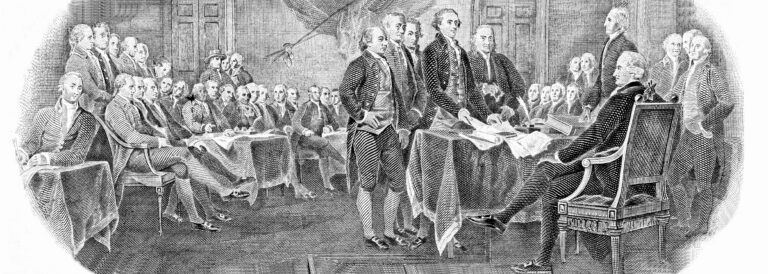
Following internal discussions, Jefferson was charged to write the first draft, which was later edited by the group, especially Adams and Franklin. The Committee of Five sent its draft to Congress in late June for further revisions. On July 2, all colonies except for New York—which abstained—voted for independence. Congress approved the formal Declaration of Independence on July 4, 1776.
Its opening words have become immortalized.
‘When in the course of human events, it becomes necessary for one people to dissolve the political bands which have connected them with another, and to assume among the powers of the earth, the separate and equal station to which the Laws of Nature’s God entitle them, a decent respect to opinions of mankind requires they should declare the causes which impel them to the separation.”
“We hold these truths to be self-evident, that all men are created equal, that they are endowed by their Creator with certain unalienable Rights, that among these are Life, Liberty, and the pursuit of Happiness…”
The Declaration of Independence is frequently referred to as one of the most crucial statements in American history and a landmark document in world history.
“The importance of the Declaration of Independence can hardly be overstated,” writes Michael Warren, a judge and scholar. “It established for the first time in world history a new nation based on the First Principles of the rule of law, unalienable rights, limited government, the Social Compact, equality, and the right to alter or abolish oppressive government.”
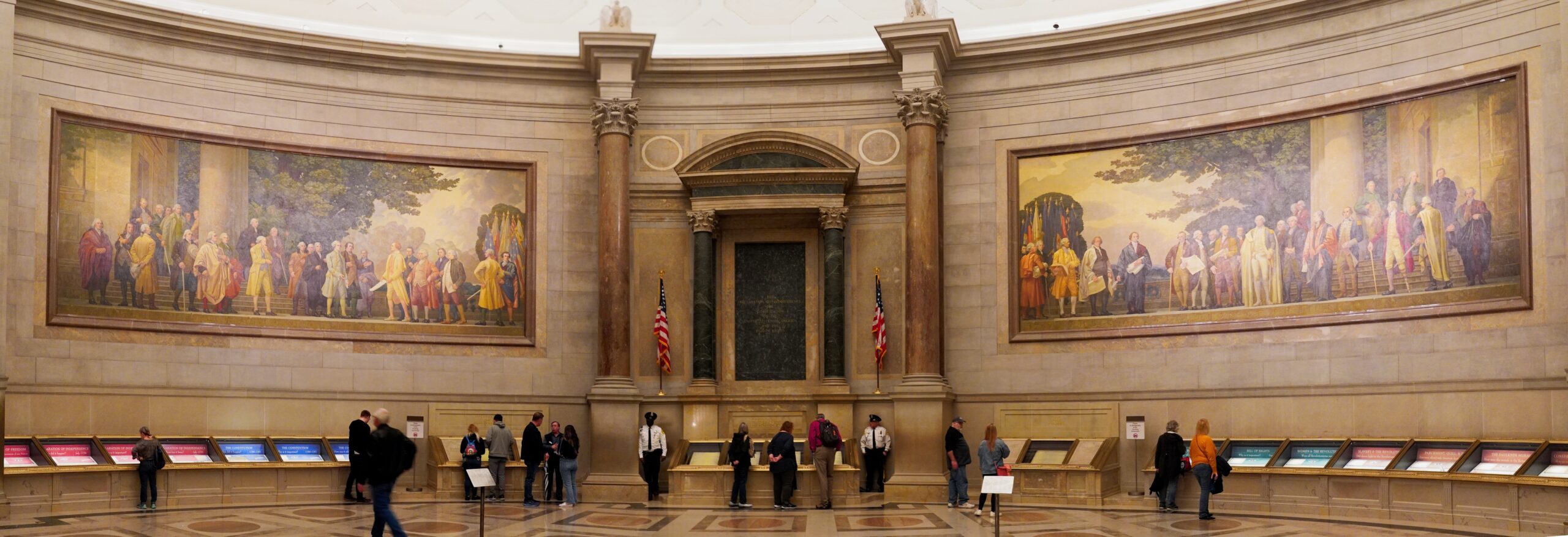
Historian David Armitage argues that the Declaration has a two-fold significance. “On the one hand, the Declaration was the birth certificate of the United States of America, the first official document to use that name publicly and the first to speak in the ‘unanimous’ voice of 13 colonies that declared themselves to be free and independent states,” Armitage writes. “On the other hand, the Declaration was a diplomatic document, directed to the ‘Powers of the Earth’ to secure their military and commercial support for the colonists’ cause against Great Britain.”
Historians estimate that when the war broke out, about 40% of the colonists supported independence, 20% were loyalists and opposed it, and 40% were neutral.
The Revolutionary War has been described as two civil wars: one between the Patriots and Loyalists, and the other between Americans and the British, which mushroomed into a world war.
The war lasted from 1775 to 1783. At its height, Britain had more than 50,000 troops in North America. At least 230,000 Americans served at one time in the Continental Army. However, the size of the force was rarely higher than 20,000 and often shrunk to as few as 3,000.
George Washington, of course, led the Continental Army. According to a popular textbook, “The American Pageant,” he was “gifted with outstanding powers of leadership and immense strength of character. He radiated patience, courage, self-discipline and a sense of justice.”
However, he was not, according to one of his most respected biographers, Thomas Fleming, a stellar battlefield leader. In seven years of fighting the British, Washington won only three clear-cut victories—at Trenton, Princeton and Yorktown—and either lost or could only claim a draw in seven other battles.
“He wore the British out by sheer persistence, with little reference to military skill, much less genius,” Fleming writes. Washington’s goals were to prolong the war, avoid major pitched battles, and patiently wait for the British to drop their guard, grow frustrated, make mistakes, and then go home.
The Americans lost more battles than they won, though several victories triggered larger geopolitical events. Notably, the victory at Saratoga in 1777 helped persuade the French to enter the war on the side of the Americans.
Historians agree that overseas assistance was crucial, even essential, to the American war effort.
France offered a Treaty of Alliance in February 1778 and provided the Americans with guns, equipment, money, ground troop, and the help of its formidable navy.
The Spanish and Dutch governments decided in 1779 to support the Americans and oppose Britain in North America. The following year, Russia’s Catherine the Great persuaded several of Europe’s neutral powers to effectively support the colonies in their war against Britain: Denmark-Norway and Sweden in 1780, the Holy Roman Empire in 1781, and Prussia and Portugal in 1782.
The grinding war turned decisively when Washington and Comte de Rochambeau’s French army trapped Britain’s Gen. Charles Cornwallis at Yorktown. He surrendered his 7,000 troops on Oct 19, 1781, effectively ending the war. Fighting sputtered on, but key action shifted to Paris where American diplomats Benjamin Franklin, John Adams and John Jay negotiated what became the Treaty of Paris.
This accord was concluded in 1783. Britain formally recognized US independence and agreed to generous boundaries for the Americans—to the Mississippi River in the West, the Great Lakes in the North, and to Spanish Florida in the South.
Many historians believe that Britain’s acceptance of its defeat in the Revolutionary War ultimately helped it regain and then expand its power. The British rebuilt their army and navy and developed an effective strategy to defeat Napoleon and cement its role as the preeminent global power of the 19th century.
In 1976, Queen Elizabeth II traveled to Philadelphia for the American bicentennial and presented a special liberty bell. She also offered an astute reflection.
“We lost the American colonies because we lacked that statesmanship to know the right time and the manner of yielding what is impossible to keep,” she said. “But the lesson was learnt. In the next century and a half we kept more closely to the principles of the Magna Carta, which have become the common heritage of both countries.”
The American victory in the war and the Treaty of Paris was a moment of triumph for the new nation. Its historical significance was amplified when Gen. Washington appeared before the Continental Congress on December 23, 1783, and resigned his military commission. This was seen as a striking confirmation of Washington’s commitment to republican values and his willingness to surrender military power. When told this was about to happen, King George is reported to have said, “If he does that, he will be the greatest man in the world.”
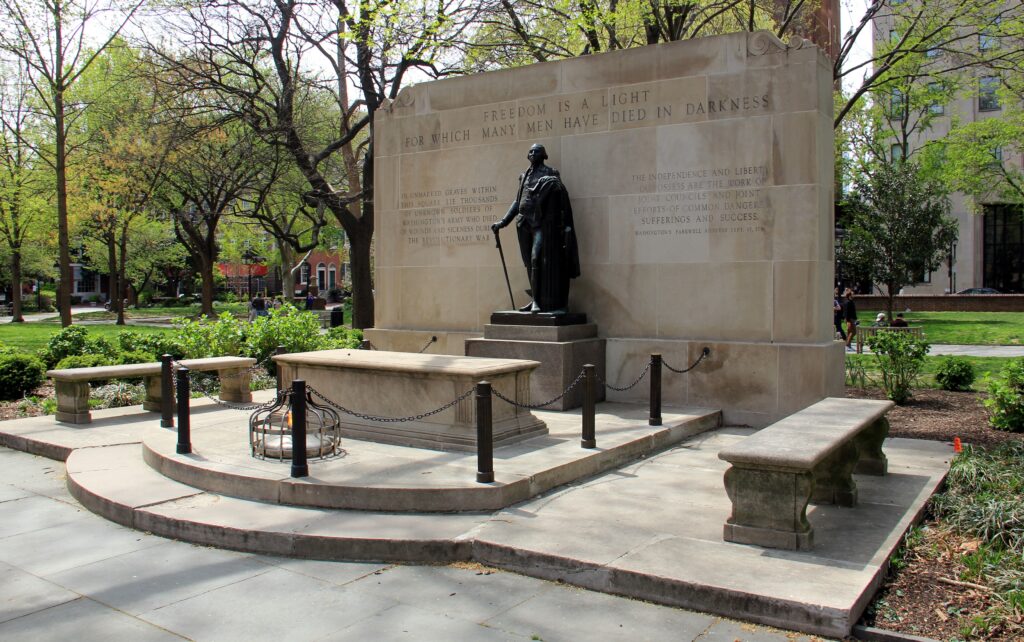
Historian David McCullough argues that we should not lose sight of the bloodshed and suffering in the conflict. “The war was a longer, far more arduous, and more painful struggle than later generations would understand or sufficiently appreciate,” he wrote. “By the time it ended, it had taken the lives of an estimated 25,000 Americans, or roughly 1% of the population. In percentage of lives lost, it was the most costly war in American history, except for the Civil War.”
However, for Washington and others in America’s revolutionary generation, their work was not over. The weakness of the new nation’s government as organized under the Articles of Confederation hamstrung the United States for nearly a decade. It prompted an effort to establish a stronger and more effective government. Washington came out of retirement to preside over the Constitutional Convention which in 17 remarkable weeks in the summer of 1787 assembled a package of historic compromises that were enshrined in the Constitution, which came into effect in 1789.
The Revolutionary War, undergirded by the Declaration of Independence and the Constitution, has served as the foundational story for the United States.
“The American Revolution has functioned, since the 18th century, as an origin story for the United States, Genesis and Matthew in one: the litany of begats, the rock upon which we would build a sovereign people,” writes historian Jane Kamensky.
For many it has been a story of triumph and inspiration, the launching of a good and successful nation. Others have focused on the inconsistency between the Declaration’s soaring values and aspirations, and the sad reality of subsequent decades of slavery and mistreatment of Native Americans.
Most analysts believe the Founders bequeathed future generations of Americans a remarkable gift. “The American Pageant,” a popular textbook, argues that Americans “began their national career with a splendid territorial birthright and a priceless heritage of freedom. Seldom, if ever, have any people been so favored.”
The enduring question for Americans in 2026 is whether we are living up to the legacy with which we have been so favored.
—
This article was originally published in our 2026 Embassy Directory. Get your copy here.
