
For women serving as ambassadors in Washington, having a seat at the table is just the starting point
The Willard Hotel, just two blocks from the White House along Pennsylvania Avenue, has been at the center of Washington’s power structure ever since its opening in 1816. Every president since Franklin Pierce has either slept there or attended an event there.
Abraham Lincoln stayed at the Willard for 10 days before his first inauguration in 1861 and reportedly wrote his inaugural address there. Julia Ward Howe wrote “The Battle Hymn of the Republic” in one of its rooms. Martin Luther King Jr. put the finishing touches on his “I Have a Dream” speech in the lobby. And Ulysses S. Grant liked to sit in a leather chair in that same lobby and smoke cigars, which is how, the story goes, the Willard gave the English language the word “lobbyist” — so many people crowded around Grant as he smoked, all looking for favors, that he started calling them exactly that.
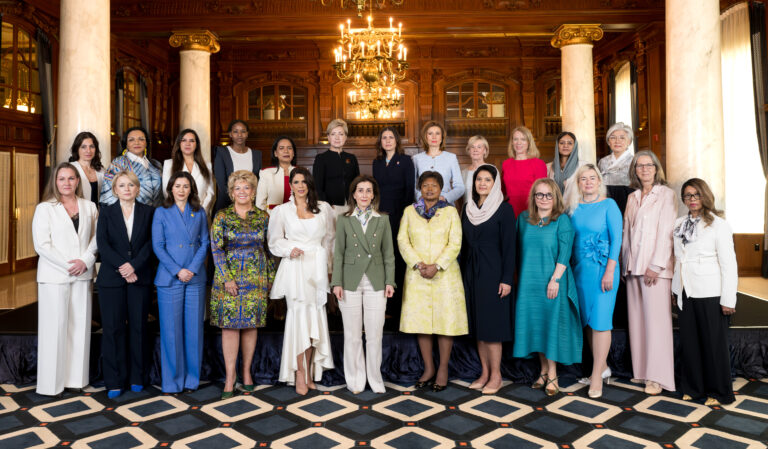
It’s a place where US history has been made and where the nation’s impact on the world has been forged—a fitting backdrop to gather 23 female ambassadors to the United States for this historic photograph. Looking at the resulting image, one can only imagine how hard many of these women—and many before them—had to fight to get into the very rooms they now run.
The first woman to serve as an ambassador anywhere in the world was Alexandra Kollontai, a Russian Bolshevik revolutionary and feminist theorist who, at age 51, was appointed Soviet ambassador to Norway in 1923. She would go on to serve in Mexico and Sweden, and by the time she retired in 1945—from a wheelchair, after a series of strokes—Norwegian parliamentarians had nominated her for the Nobel Peace Prize.
Technically, there was one woman diplomat before her: Hungarian suffragette Rózsa Bédy-Schwimmer, who was appointed minister to Switzerland in 1918. She lasted just two months before several nations, including the United States, pressured Hungary to recall her. The world wasn’t ready to hear from a woman. History is not always tidy.
After Kollontai, the firsts came slowly, one country at a time, and usually decades apart. In the United States, women weren’t permitted to join the diplomatic corps until 1922. The first female chief of mission, Ruth Bryan Owen—daughter of William Jennings Bryan, and herself a former congresswoman from Florida—was appointed in 1933.
Eugenie Anderson was the first woman to hold the actual title of US ambassador, sent to Denmark by President Truman in 1949. She had to overcome open skepticism in the press and within the State Department about whether a woman could do the job. Not only did she do the job, she negotiated a mutual defense agreement, signed a friendship and commerce accord with Denmark—becoming the first American woman to sign a treaty—and launched what she called “people’s diplomacy,” an approach built on listening, learning the language and treating ordinary people as the real audience for diplomatic work. It’s an approach the ambassadors who gathered for this photo know well.
In Great Britain, women weren’t even permitted to take the Foreign Office entrance exam until 1946, and even then, any woman who got married was forced to resign. That rule wasn’t lifted until 1972, which was also the year France appointed its first female ambassador.
The Juggle
Milena Mayorga, El Salvador’s ambassador to the United States, did not present her credentials in person when she arrived in Washington in December 2020; rather, she mailed them. The world was locked down, and the formal ceremony that typically marks the beginning of an ambassadorial posting—standing before the head of state, shaking hands—had been replaced with an envelope.
It was an unusual start, but Mayorga is an unusual ambassador. A former beauty queen, prime-time television host and congresswoman who won her seat in El Salvador’s capital district, she didn’t land on Embassy Row through the traditional diplomatic pipeline. President Nayib Bukele asked her personally. Five and a half years later, she’s still in her post.
Rwanda’s Mathilde Mukantabana presented her credentials in July 2013—making her, by most reckonings, the longest-serving current female to the United States. She arrived when only a handful of women were leading embassies in Washington. Twelve years later, she’s watched that number grow and accumulated wisdom no briefing book could provide.
Mukantabana has watched four administrations come and go, and seen global crises unfold and priorities shift. In Washington, where the political cycle moves fast and attention spans are short, staying power gives someone a different kind of influence.
“People know where you stand,” Mukantabana said. “They know your story.”
Luxembourg’s ambassador, Nicole Bitner-Bakshian, has been working in diplomacy for 26 years, long enough to have a clear-eyed philosophy about it.
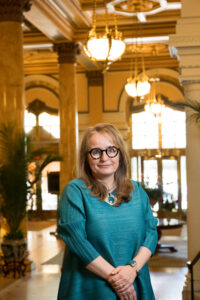
“You are a diplomat 24/7,” she said. “This is a life you choose, not a job.”
Luxembourg, she points out, is surrounded by Belgium, Germany and France—its entire identity forged upon building bridges. That ethos shows up in how Bitner-Bakshian practices diplomacy.
“We often work quietly,” she said, “and that can be very effective and efficient in a world where people think the person who shouts the loudest gets the most.”
She and her husband, a journalist, raised their two daughters, now 19 and 23, moving from post to post. Every move was a family decision, she said, weighing what was best for her country, her career and her family.
There’s a particular closeness, she said, that comes from being a diplomatic family far from home. “You don’t have extended family nearby, so you grow much closer as a unit.”
The family question runs through all three women’s experiences.
Mukantabana names something the others leave implicit: diplomacy doesn’t respect weekends or school calendars. Her husband died in 2010, leaving her to raise her three children on her own, while also managing the demands of a diplomat alongside those of parenting.
“I’ve tried to be intentional about the moments that matter most. Not every moment, but the right ones,” she said, adding: “This question—the juggle—is rarely asked of male ambassadors. And that itself tells us something important about the work still to be done in how we think about leadership.”
Mayorga’s husband is a pilot based in El Salvador and he visits her when he can. Her daughter went back to El Salvador to finish high school with her longtime friends; her son, who plays baseball for the national team and studies electrical engineering at Johns Hopkins, sometimes attends important events with her.
Bitner-Bakshian said the reality of a long diplomatic career is that it requires a partner who is ready to fully participate in it and who’s willing, in many cases, not to work.
“You have to have a family who is ready to do this work with you,” she said. “If you have the right mindset and your family is in the right spirit, you can do it.”
Delivering Proof
None of these ambassadors describe the job as glamorous, exactly. All are specific about the harder parts.
For Mayorga, one of the sharpest ongoing challenges has nothing to do with policy: navigating professional relationships as a woman who is warm, accessible, and—she is straightforward about this—attractive in a way that some men misread.
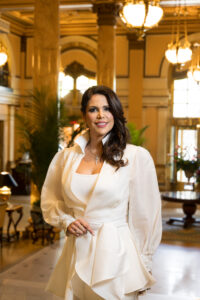
“Because of my appearance, I have to be very careful that they know it is only a relation because of my job,” she said.
She rarely takes a one-on-one meeting without a member of her team present. A solo coffee with a colleague can end up as a photo, and a photo can become a story that isn’t true.
But there are benefits to being a woman in diplomacy, as well. Bitner-Bakshian said she is sometimes able to access spaces her male counterparts cannot, particularly in countries where society is more gender-segregated. A woman diplomat may have access to an entire half of a society a male colleague would never be able to reach.
Mukantabana has navigated both sides of that coin. When conversations turned to women’s rights, health or education policy, she said, being a woman was an asset. She carries particular authority on the subject because Rwanda’s parliament is now 61% female, and half of her country’s cabinet are women.
“I’m not making an argument,” she said. “I’m delivering proof.”
But in domains traditionally coded as male—security, geopolitics and strategic affairs—she still has had to fight to be taken as seriously.
“I’ve had to deliberately stake out Rwanda’s position on these issues with the same force, the same stamina and confidence I bring to any other domain.”
The Weight of the Work
For all 23 ambassadors in this photo, it’s a job with stakes that are exceptionally high. Mayorga said that when she was diagnosed with cervical cancer and underwent radiation, chemotherapy and brachytherapy treatments at a Virginia hospital, “nobody noticed because I kept working.”
She kept her hair, her schedule and her smile, advocating for opportunities for her nation, even when her own health and energy lagged. She even helped orchestrate Bukele’s first-ever state visit to the White House under the Trump administration.
For Mukantabana, the moment that comes back to her most often wasn’t a trade deal or an investment announcement. For years, she said, there was resistance in Washington and in international institutions to calling what happened in Rwanda in 1994 by its full and accurate name: the genocide against the Tutsi.
“I spent years,” she said, “myself and my colleagues, in conversations with members of Congress, State Department officials and community leaders, making the case for why that naming matters, not only for Rwanda, but for the integrity of memory and the credibility of ‘never again.’”
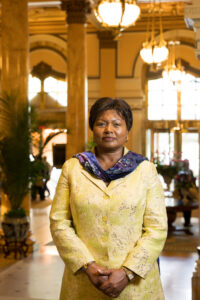
When US governors began issuing proclamations designating April 7 as a day of reflection and commemoration of the 1994 genocide against the Tutsi—and when the United States formally recognized that designation—she felt the full weight of what the work had required from her.
“Years of patient diplomacy,” she said. “It reminded me that this work matters beyond trade figures and investment deals. It’s about dignity, truth and history.”
That accomplishment mattered to her people, but also to herself: Mukantabana and her husband lost more than 100 family members, including her parents, two brothers and three sisters, in the bloodshed.
For all three women, and in all things, the measure of the job ultimately comes down to people.
“What makes you proudest is when you achieve a certain impact on people,” said Bitner-Bakshian. “When you get people together who wouldn’t be together otherwise, brokering connections. That’s really the essence of it.”
She worries about the current moment in global affairs, about the sheer volume of noise that makes genuine understanding harder. The COVID pandemic, she said, did real damage to diplomacy, and the world is still absorbing the impact of that damage. Diplomacy is, at its core, about people—and when diplomats couldn’t meet in person, global relations suffered.
The women in this photograph are standing on a lot of history, and they know it.
“When you enter that room, as a diplomat, you carry more than yourself,” Mukantabana said. “You carry the possibility and the responsibility of opening that door a little wider for the next person behind you.”
In the Willard’s lobby—where Grant smoked cigars while men jockeyed for power, where King finished a speech that changed a nation, that door today is open a little wider than before.
–
All photos by Ray Alghadban. This article was originally published in our 2026 Embassy Directory. Get your copy here.
