
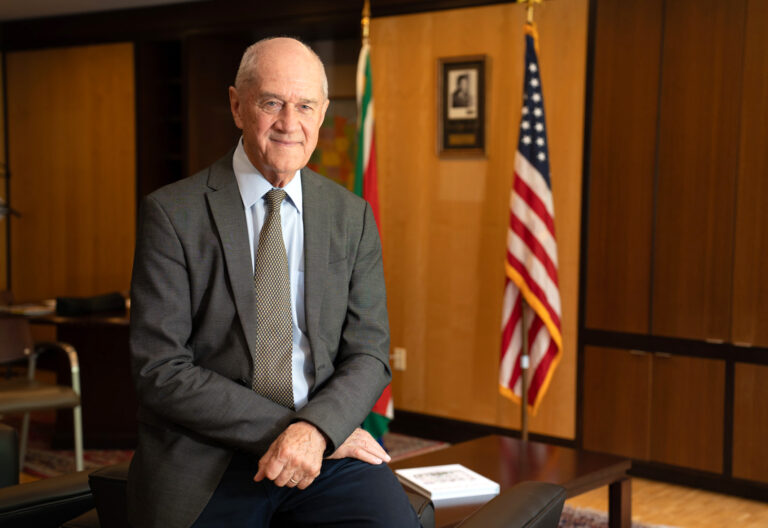
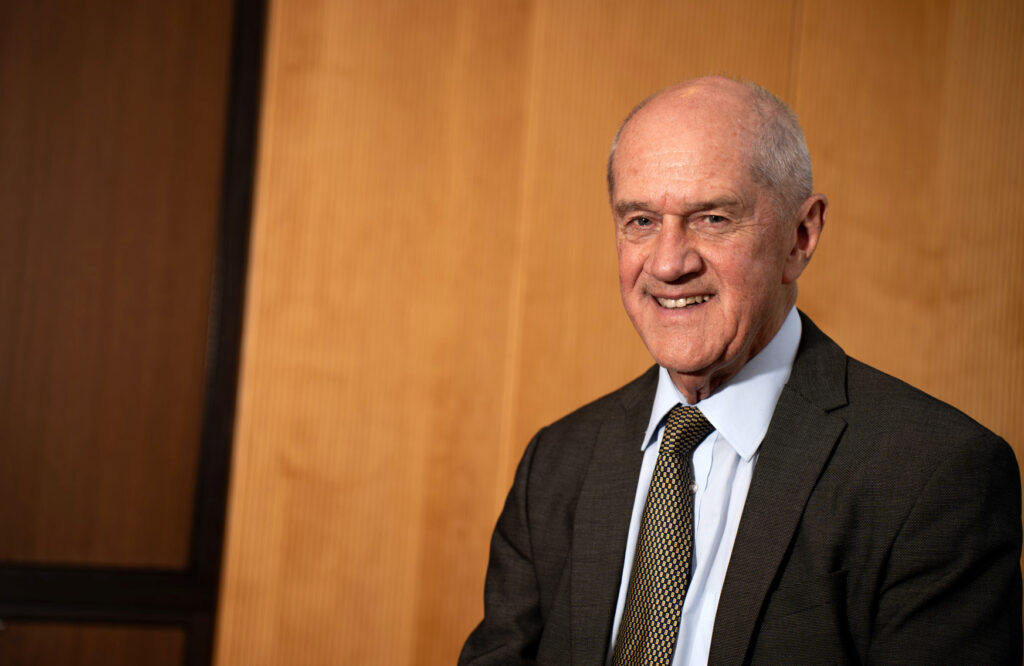
At 79, Roelf Meyer should have been retired already.
Born in 1947—the year before South Africa officially instituted apartheid—Meyer came from a white Dutch-descended Afrikaner family and studied law at the University of the Free State, where he was president of the conservative Afrikaanse Studentebond organization. He later practiced law in Johannesburg and Pretoria, and became a member of parliament in 1979.
A rising star in the ruling National Party, Meyer served under three successive presidents: P.W. Botha, F.W. de Klerk and Nelson Mandela. In 1990, Mandela—a lifelong activist with the African National Congress (ANC)—was released after 27 years behind bars for sabotage, treason and violent conspiracy.
Three years later, Meyer became the government’s chief negotiator and established a lifelong friendship with his ANC counterpart, Cyril Ramaphosa. Once those talks concluded, the up-and-coming politician became its chief representative in the Transitional Executive Council.
Meyer joined a national unity government in 1994, when Mandela became president, going on to co-found the United Democratic Movement. He eventually joined the ANC.
After leaving politics in 2000, Meyer turned his focus to the timber industry and his consulting business. He joined Tufts University’s Strategy Committee of the Project on Justice in Times of Transition, and served as chairman of the Civil Society Initiative in South Africa.
In mid-April, Ramaphosa—now South Africa’s president—appointed him to his current position.
“I entered politics when I was 32, and have been in the public eye for the greater part of my life,” Meyer said. “I have a tested record, and most South Africans see me as a reliable and credible person who comes with experience. I’m not here for self-interest.”
Meyer, speaking exclusively to The Washington Diplomat earlier this month, has arrived at a particularly tense time in bilateral relations.
Back in March 2025, President Trump declared Meyer’s predecessor, Ibrahim Rasool, persona non grata and expelled him after Rasool had accused the president of “mobilizing supremacism” and trying to “project white victimhood as a dog whistle” as the white population faced becoming a minority in the US.
Trump’s move followed South Africa’s passage of an expropriation law he claims discriminates against white farmers. This, along with its support of Iran and alleged backing of Hamas, led the White House to declare an end to all US federal funding to South Africa, which in 2023 came to $440 million.
As we reported at the time, Secretary of State Marco Rubio replied that Rasool, 62, was “no longer welcome in our great country” and that he was “a race-baiting politician.” A lower-level State Department official called the South African diplomat “obscene.”
Improving relations with Washington of crucial importance
For over a year, South Africa’s embassy fronting Massachusetts Avenue lacked an ambassador. Then in March 2026, Trump named conservative media mogul Leo Brent Bozell III as US ambassador in Pretoria, and Meyer arrived in Washington the following month.
“Our relationship started to go in the wrong direction because of a lack of engagement,” he said, explaining that it is now crucial to actively engage with Capitol Hill, the White House, the State Department and other key Washington institutions.
“The biggest damage is that we were unrepresented in the US for more than a year, and that left a vacuum. The US was not represented in South Africa more or less for the same period,” Meyer said. “At least now we’re back on track. Ambassador Bozell and I have developed a very good understanding, and we talk frequently with each other. We are busy repairing that damage.”
While Meyer’s appointment was generally well-received back home, the BBC quotes Julius Malema’s Economic Freedom Fighters party as saying it was “politically tone deaf” and a “deliberate insult to our democratic struggle.”
The BBC added that “the most stinging criticism came from right-wing Afrikaner groups AfriForum and Solidarity Movement” and quoted AfriForum leader Kallie Kriel as calling Meyer an “ANC cadre whose history shows that he is someone who is willing to dramatically reposition himself to suit his own personal interests.”
Meyer freely concedes that repairing the damage won’t be easy, given the many issues that separate Washington and Pretoria—not to mention the political uncertainties back home.
“The ANC lost its majority in the 2024 elections. That resulted in the formation of a coalition with nine other parties, so now we have a government of national unity consisting of 10 different parties,” he explained. “That’s an indication of what will follow in the future. It’s very unlikely we’ll see any political party receiving 50% in the foreseeable future.”
In the meantime, he said, his task in Washington is quite clear: to contribute toward establishing a good relationship with the United States.
“We regard the US as a very important partner when it comes to business, investment and the political sphere. That relationship has existed forever—from the demise of apartheid through the Sanctions Act of 1986, and on an ongoing basis after the change from apartheid to democracy,” Meyer said. “And I’m here as somebody who experienced that relationship over decades.”
Black economic empowerment, land expropriation among key issues
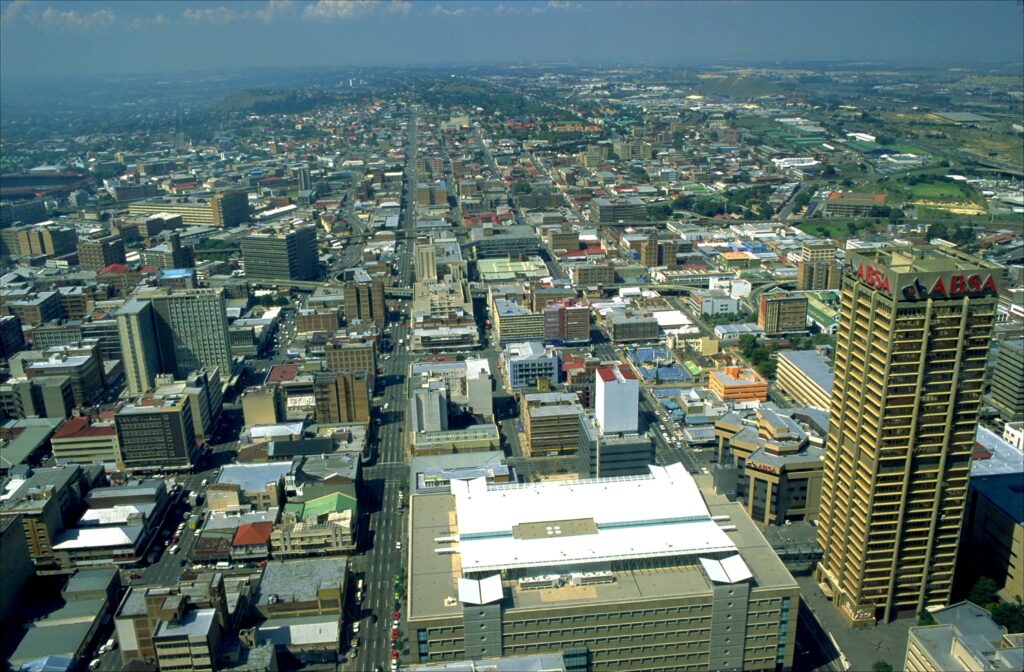
South Africa, with about 65 million people, is by far the continent’s largest economy. Its GDP of around $480 billon represents 15% of Africa’s total GDP, eclipsing oil-rich Nigeria, which has nearly four times as many inhabitants.
Yet South Africa’s official unemployment rate is a crippling 36%—and represents Meyer’s most urgent priority as ambassador.
“My main objective is to create more jobs in South Africa,” he told The Diplomat. “Since the US is the biggest economy on Earth and has the potential to help us, I’m going to do everything I can to strengthen that relationship.”
At the end of 2024, total US investment in South Africa came to $7.05 billion, representing 5.5% of the $113 billion in foreign direct investment (FDI). That makes the United States the fourth biggest direct investor in South Africa after the Netherlands, Britain and Belgium. The total is significantly higher if including US portfolio investment such as stocks and bonds as well as US government funding.
According to the US Bureau of Economic Analysis, more than 600 US companies now operate in South Africa, accounting for 10% of the country’s GDP.
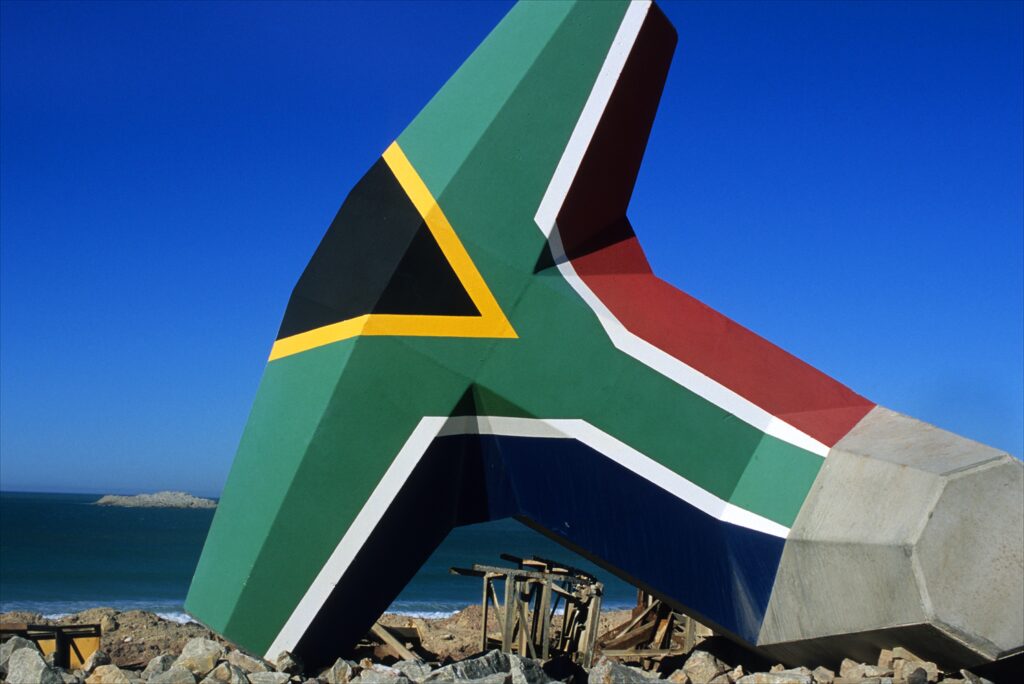
But roadblocks stand in the way, among them Ramaphosa’s Expropriation Act, which gives the state the authority to take over privately owned land—in some cases without compensation to owners. Most private farmland is still owned by whites, but the government says the changes are necessary in order to boost black land ownership.
Another dispute focuses on South Africa’s Black Economic Empowerment (BEE). Since 2003, this affirmative action program focuses on the following pillars: ownership (at least 25% black-owned); management control (50% of voting board members must be black); skills development; preferential procurement; enterprise and supplier development; and socioeconomic development.
The problem, said Meyer, is that the Trump administration is demanding that US companies—which currently employ more than 250,000 South Africans—be exempt from the law.
“The US feels there should be no restrictions for American companies operating in South Africa. It’s very important that we keep them in South Africa,” he said. “It’s clear from our side why we need BEE. We have to argue our case and see where we can meet each other. The South African authorities have reached out and made proposals, and it’s still under discussion.”
He added: “I’ve had meetings already with representatives from the State Department, and I think we’re going to have a meeting of minds at some point. It’s an ongoing process. Essentially, it’s about correcting the wrongs of the past that came about as a result of apartheid.”
Meanwhile, CNN reported in mid-July, the US has given political asylum to 7,730 foreigners—virtually all of them white South Africans—in the 18 months since the new rules were enacted.
For Meyer, Trump’s controversial immigration policy hits home.
“It affects me directly because I’m an Afrikaner. For this reason, I have a deep concern about that ruling because it is not necessarily based on a correct understanding of the situation,” he said, suggesting that it stems from false claims that violent against farms are aimed specifically at white Afrikaner communities.
“I don’t agree with that,” he said. “It’s true that there are farm attacks in South Africa, but this is part of violent crime in general. Our highest crime rates are in the townships and parts of the Western Cape. And in fact, over the last year or two, attacks in rural communities and farms has actually come down quite significantly.”
Pretoria’s involvement in the Israeli-Palestinian conflict
One of the biggest casualties of Trump’s wrath is the fight against HIV/AIDS.
Through the President’s Emergency Plan for AIDS Relief (PEPFAR) that was inaugurated by the administration of George W. Bush, South Africa received $456 million in 2024, Politico reported. That dropped by more than half, to $213 million, in 2025, and so far this year, South Africa has received only $25 million to fight HIV.
This follows Trump’s threat to punish South Africa for failing to address the president’s concerns about alleged mistreatment of its white citizens.
“This was a hit in the face,” said Meyer, whose country is home to 7.8 million carriers of HIV. That’s the highest number in the world, and three times as high as Nigeria, which has 243 million inhabitants. He said PEPFAR covered about 20% of the cost of distributing HIV retroviral drugs in South Africa—money that now needs to come from somewhere else.
Since leaving politics, Meyer has joined 15 missions in conflict zones ranging from Northern Ireland and Kosovo to Sri Lanka, Colombia, Bangladesh and Sri Lanka. Beginning in 2000, he said, “I became intimately involved in efforts to help with the peace process in the Middle East.”
That involved travel to Israel, including visits to Tel Aviv, Jerusalem and the West Bank.
“We had access to the Palestinians and Israelis, and we invited representatives from both sides to come to South Africa, where we shared our experience with peacemaking, about how we avoided a civil war and ended up with a peaceful transition from apartheid to democracy through dialogue,” he said.
Yet Pretoria’s ties with Jerusalem cooled as Mandela increasingly identified with the Palestinian cause, and Israel began to distrust his government.
In 2019, South Africa downgraded its ties with Israel following the Jewish state’s killing of Gazan border protesters. Relations further deteriorated on Dec. 29, 2023, when South Africa filed a case against Israel at the International Court of Justice, alleging that Israel committed genocide and war crimes against Palestinians during its war with Hamas in Gaza.
Earlier this year, South Africa declared Ariel Seidman, Israel’s chargé d’affaires in Pretoria, persona non grata and gave him 72 hours to leave, citing “insulting attacks” against Ramaphosa on social media.
Asked whether his country should restore full relations with Israel, Meyer acknowledged that as South Africa’s ambassador in Washington, he’s in a difficult position to comment.
“If we want to help with the process, then we have to be there. Unfortunately, that relationship through formal representation doesn’t exist,” Meyer said. “I’ve made it very clear to representatives of the Trump administration that we can—even now—play a role as far as the Middle East is concerned. But you can’t influence a situation if you don’t have dialogue.”
